Omron’s C6 Series AC servo went on sale in Europe on 7 October 2026 with a stated power range of 50 W to 7.5 kW, an EtherCAT interface, a 26-bit encoder and a 3.5 kHz speed response. If you buy spare parts for a plant that runs Omron axes, the launch changes almost nothing about what you should hold on the shelf today — and it changes quite a lot about how you should quote the next failure.
The reason is a sentence in Omron’s own announcement: the C6 is positioned for light-duty axes, “while the existing 1S Series continues to provide the best solution for long-lasting and high-performance applications with a power range up to 15 kW”. The C6 is therefore an addition to the Omron motion catalogue, not a replacement for it. Two product families now cover overlapping ratings with different order codes, different encoder architectures and different safety options — which is exactly the situation that produces wrong-part failures in a maintenance store.
Our practical conclusion, before the detail: treat the C6 as a machine-builder part, not a spares part. A brand-new servo family has no field installed base, no failure history and no second-source stock, so it cannot shorten the 10–39 week waits we documented for PLCs in our analysis of 2026 automation lead times. The axes that will actually fail in your plant this year are the ones already running — and those get fixed with parts you can buy now from our servo motors and drives catalogue.
Key takeaways for buyers
- The C6 launched in Europe on 7 October 2026 at 50 W–7.5 kW, in 230 V single-phase and 400 V three-phase models, with EtherCAT and Sysmac Studio integration.
- Omron states explicitly that the 1S Series continues, and 1S still reaches 15 kW — a rating the C6 does not offer.
- European C6 drive order codes all end in -GS and none of them is a 1S code. You cannot order a C6 by adapting an existing 1S part number.
- The C6’s absolute encoder is described by Omron as battery-backed; the 1S is described as holding multi-turn position without a battery. That is a maintenance difference, not a spec-sheet footnote.
- On headline numbers the C6 matches Mitsubishi’s flagship MELSERVO-J5 (26-bit, 3.5 kHz) and exceeds Panasonic’s MINAS A6 (23-bit, 3.2 kHz) — but interchangeability is still zero across all three.
What Omron actually released
The European drive catalogue currently lists nine C6 amplifier ratings. All are EtherCAT types with hardwired Safe Torque Off, and all carry the -GS suffix that Omron’s European order codes use:
| C6 drive order code | Supply | Rated output |
|---|---|---|
| R88D-C6N02H-ECT-GS | 230 V single or three phase | 0.2 kW |
| R88D-C6N08H-ECT-GS | 230 V single or three phase | 0.75 kW |
| R88D-C6N10H-ECT-GS | 230 V single or three phase | 1 kW |
| R88D-C6N15H-ECT-GS | 230 V single or three phase | 1.5 kW |
| R88D-C6N15F-ECT-GS | 400 V three phase | 1.5 kW |
| R88D-C6N30F-ECT-GS | 400 V three phase | 3 kW |
| R88D-C6N50F-ECT-GS | 400 V three phase | 5 kW |
| R88D-C6N60F-ECT-GS | 400 V three phase | 6 kW |
| R88D-C6N75F-ECT-GS | 400 V three phase | 7.5 kW |
Two details in that table matter more than the headline power range. First, the smallest European C6 drive is 200 W, even though the series starts at 50 W — the 50 W rating sits on the motor side, where the catalogue opens with R88M-C6H05030T-S2-GS at 0.16 Nm and 3000 r/min. Second, the “H” and “F” letters are not interchangeable: “H” is the 230 V family, “F” is 400 V, and only the 1.5 kW rating exists in both. A buyer who reads “1.5 kW C6” as a part number will get the wrong amplifier roughly half the time.
The motor side is deliberately conventional for a cost-reduced series: Omron lists pre-assembled motor cables, a compact frame, and an absolute encoder with battery backup that Omron says is “also configurable for incremental operation”. The cables and connectors are therefore a catalogue item on day one, and the encoder itself is a serviceable part rather than a sealed assembly. Where an application needs Omron’s full closed-loop option — a second encoder at the load — that second device is a separate component too, in the same class as this SICK DFS60B incremental encoder.
Where the C6 and the 1S overlap — and where they cannot substitute
Omron’s two European product pages, read side by side, show why “is the C6 a drop-in for my 1S?” is the wrong first question. They overlap in the middle of the range and diverge at both ends.
| Attribute | Omron C6 (Europe) | Omron 1S (Europe) |
|---|---|---|
| Stated ratings | 230 VAC 50 W–1.5 kW; 400 VAC 850 W–7.5 kW | 230 VAC 50 W–1.5 kW; 400 VAC 400 W–15 kW |
| Smallest drive listed | 200 W (R88D-C6N02H-ECT-GS) | 100 W (R88D-1SN01H-ECT) |
| Largest drive listed | 7.5 kW (R88D-C6N75F-ECT-GS) | 15 kW (R88D-1SN150F-ECT) |
| Encoder | 26-bit, absolute with battery backup, configurable incremental | 23-bit, multi-turn position held without battery backup |
| Network | EtherCAT, 125 µs cycle | EtherCAT |
| Safety | Hardwired STO, PLe Cat. 4, SIL 3 | Hardwired STO PLe SIL 3 plus network STO PLd SIL 2, and separate “with Safety Functionality” models |
| Connectors | Pluggable for power, motor, encoder and I/O | Pluggable, plus screw-less push-in terminals |
| Order-code suffix | -GS on every European drive | No -GS suffix |
The most consequential line is the encoder row. Omron describes the 1S as holding high-resolution multi-turn position without battery backup, and the C6 as an absolute encoder with battery backup. For a maintenance team that means a new consumable in the drawer: a battery, a replacement procedure, and a known failure mode where absolute position is lost and the axis must be re-homed. It also means the C6’s incremental configuration option is a genuine fallback, not a marketing alternative.
The second is the -GS suffix. Because the C6 codes are new strings rather than variants of existing ones, any system that resolves 1S part numbers will not resolve a C6 part number — and a C6 quoted against an obsolete 1S position is a specification change, not a substitution. If you are maintaining a parts index or an ERP item master, that distinction has to be made deliberately, in writing, by whoever owns the machine’s safety documentation.
How the C6 compares with Panasonic and Mitsubishi
Omron’s positioning is explicit: an affordable servo with modern technology for light-duty axes. The comparison with Panasonic’s MINAS A6 and Mitsubishi’s MELSERVO-J5 is therefore about where the C6 sits relative to the incumbent mid-range parts, not about which is “best”.
| Series | Encoder | Speed response | EtherCAT cycle | Power range as published |
|---|---|---|---|---|
| Omron C6 (2026) | 26-bit, absolute with battery | 3.5 kHz | 125 µs | 50 W–7.5 kW |
| Omron 1S | 23-bit, multi-turn without battery | not stated on the product page | EtherCAT type | 50 W–15 kW |
| Panasonic MINAS A6 / A6B | 23-bit absolute or incremental, battery-less absolute option | 3.2 kHz (3200 Hz on A6B) | 125 µs, 100 Mbps | 50 W–22 kW |
| Mitsubishi MELSERVO-J5 | 26-bit battery-less absolute | 3.5 kHz | ≥125 µs (MR-J5-G-N1) | 200 V and 400 V amplifier classes |
Read that table as a buyer, not as an engineer. The C6 brings 26-bit and 3.5 kHz into the entry-mid bracket, matching the numbers Mitsubishi publishes for its current flagship J5 line — where MR-J5-G amplifiers run a CC-Link IE TSN cycle down to 31.25 µs and the EtherCAT variant MR-J5-G-N1 down to 125 µs. Panasonic’s A6 family stays at 23-bit and 3.2 kHz but reaches 22 kW, so it is not displaced at the top of the range either.
The commercial consequence is that a light-duty axis can now be specified cheaply inside the Omron ecosystem, which means more Omron axes in the field over the next five years — and more of them arriving with a battery-backed absolute encoder. That is a stocking decision to make now, while the parts are cheap, not after the first line stop. It is also why the practical cross-brand question in a mixed plant is never “can I fit a Panasonic motor to an Omron drive” — it is “do I have the amplifier that this machine was built around, on a shelf, at all”. For the FANUC, B&R, ABB and Siemens servo fleets that dominate most European cabinets, that answer has to come from the used-and-new spares channel.
What actually fails on a servo axis
Across the servo work we quote every week, failures cluster in a predictable order, and the amplifier is only first because it is the most exposed electronic assembly.
- Drive electronics. DC-bus capacitors and IGBT stages age out, typically after years of thermal cycling; on robot cells the bleeder and braking hardware go first, like these ABB 3HAC032586-001 bleeder units.
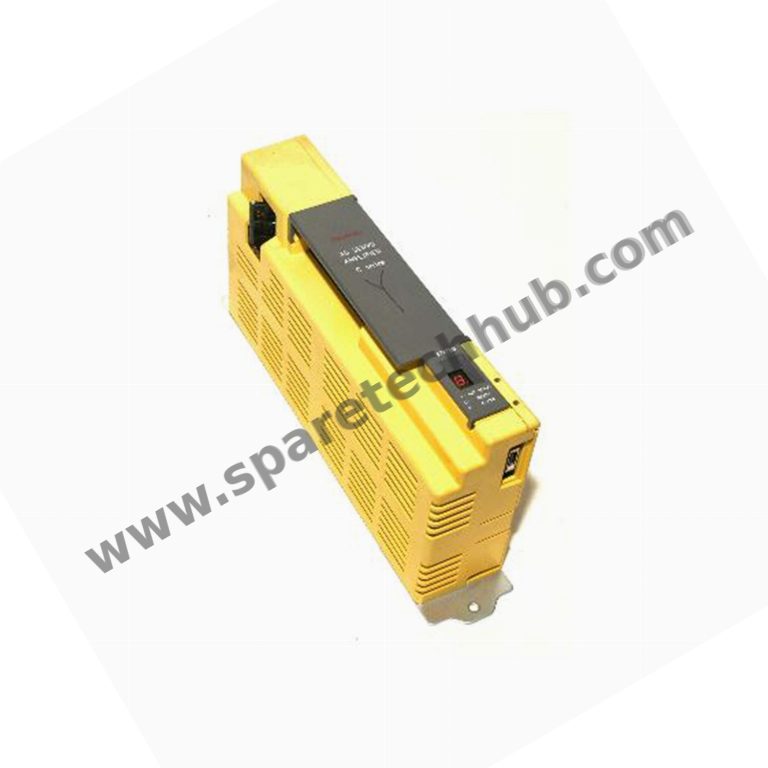
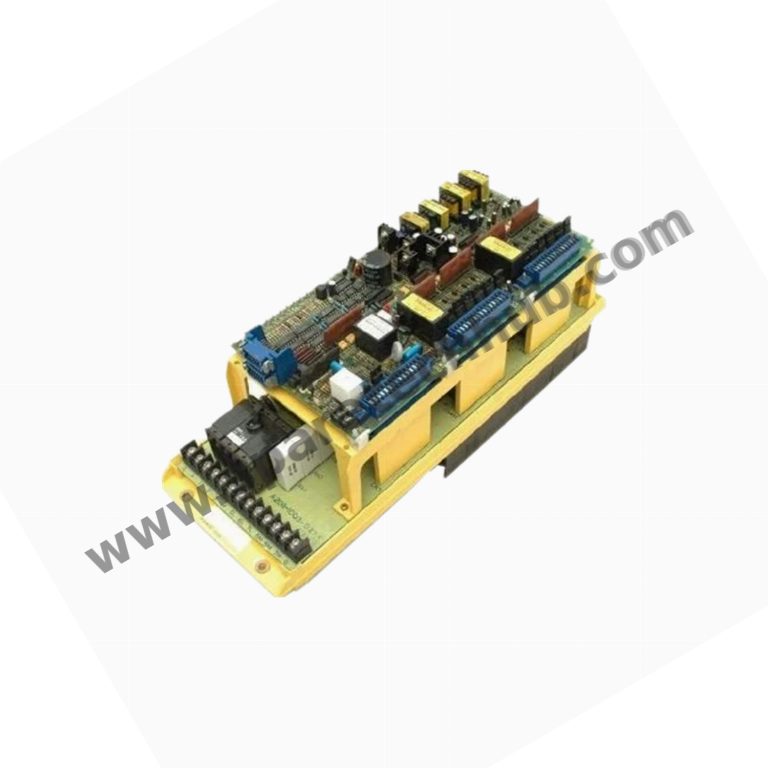
- Amplifier modules in multi-axis frames. A single failed axis module takes the machine down even though the mechanical motor is fine — the common fix on FANUC cabinets is a replacement module such as an A06B-6047-H003, A06B-6050-H102, A06B-6058-H005 or A06B-6066-H003, and the wider family is in our FANUC CNC spare units guide.
- Feedback. Encoder cables and connector contacts fail far more often than encoders; when the feedback device itself goes, you need the matching resolution and protocol, which is why we keep parts like the Siemens 1FK7022-5AK71-1LH0 servo motor and the SICK DFS60B encoder catalogued with their exact interface data.
- Rotating hardware. Bearings, shaft seals and brake linings wear on schedule, and hygienic-market motors take the worst of it — the stainless B&R 8JSB31.ee050ff00-0 and 8JSQ41.ee030ffgg-0 servo motors we list are a good example of a washdown motor whose options (brake, oil seal, key) are part of the part number.
- Motors that are actually fine. A complete AC servo motor such as the FANUC A06B-0064-B203 is often replaced because nobody could prove the drive was the fault; a documented swap-test on the amplifier saves the cost of the motor.
Where the C6 changes this list is narrow but real. Omron’s stated design intent — pluggable connectors for power, motor, encoder and integrated I/O, a constant drive height up to 3 kW, and a smaller footprint to reduce cabinet size — is a maintenance story. Constant height makes panel spares predictable; pluggable connectors make a hot-swap possible without re-terminating. Compare that with the older practice of a screw-terminated drive, where a replacement costs an hour of labour rather than ten minutes.
What the C6 does not change is the supply position. A servo family released this month has no refurbishment channel, no surplus stock and no cross-reference table. If your plant orders a machine built on C6 axes next year, the practical spares route for the first two or three years is the OEM distribution chain, at whatever lead time Omron’s channel can commit — which is why we would not treat a C6 as an availability answer today, in a market where drive and motion parts still sit at the long end of the recovery we tracked in our 2026 lead-times report.
A six-step check before you order anything against a C6 position
- Confirm the family. If the machine was built before October 2026, its Omron EtherCAT servo is a 1S (or older), not a C6 — and the part number on the nameplate is the authority, not the series name in a brochure.
- Read the voltage letter. “H” is 230 V, “F” is 400 V. At 1.5 kW both exist.
- Check the suffix. European C6 drives and motors are ordered with -GS; a code without it is a different product.
- Check whether the axis is absolute. A battery-backed absolute encoder needs the battery in the spares kit and a homing procedure after a battery change.
- Check the safety claim. If the machine’s STO was validated on a 1S network-STO PLd/SIL 2 arrangement, a C6 with hardwired STO only is a design change, and the safety documentation has to be reissued.
- Only then decide what to hold. For a mixed fleet, the highest-value stock is the amplifier family already installed, from the servo drives category — not the newest launch.
What we stock, and what we do not
To be direct about it: Omron is not in our catalogue today. We do not list C6 or 1S amplifiers, and we will not quote a part we cannot source and test. What we do carry is the servo and drive inventory that fails in the rest of the cabinet — VFDs and inverters, PLCs and controllers, Schneider Electric and SICK sensing and drive parts, and the ABB robotics spares covered in our ABB Advant and robotics guide. If a C6 axis is on your critical path, we would rather tell you that plainly than sell you a substitution.
Send us the nameplate text — order code, supply voltage, rated output and the encoder type — and we will confirm in writing whether it is something we can supply, test and ship, or whether you need the Omron channel instead. See the brand index for the full list, or contact us with the part numbers you want quoted; quotes on stocked servo parts are returned within one business day, and the FAQ page covers condition grades and testing.
Frequently asked questions
Is the Omron C6 a replacement for the 1S servo series?
No. Omron’s launch announcement states that the C6 covers light-duty axes from 50 W to 7.5 kW “while the existing 1S Series continues to provide the best solution for long-lasting and high-performance applications with a power range up to 15 kW”. The 1S remains in the European catalogue with its own order codes, and it still covers ratings — up to 15 kW — that the C6 does not offer.
Can I fit a C6 drive to an existing 1S motor, or the other way round?
Do not assume either direction works. The two series use different order-code families, different encoder architectures — 26-bit with battery backup on the C6, 23-bit multi-turn without battery on the 1S — and different safety options. A substitution of that kind is a machine modification: it changes the validated safety function and the homing procedure, and it needs the manufacturer’s confirmation before you rely on it.
Why do all European C6 part numbers end in -GS?
That is how Omron’s European ordering pages publish the series: every listed C6 drive, from R88D-C6N02H-ECT-GS at 0.2 kW to R88D-C6N75F-ECT-GS at 7.5 kW, carries the -GS suffix, as do the C6 motors. It is a regional ordering code element, so a part number without it is not the same line item and should not be ordered as a substitute.
Does the C6 need a battery?
If you use it as an absolute encoder, yes. Omron describes the C6 encoder as a 26-bit device configurable as incremental or absolute with battery backup, and lists “Absolute with battery” as the encoder type for every C6 motor in the European catalogue. That adds a consumable and a re-homing procedure that the battery-less 1S design does not have.
Is the C6 better than Panasonic MINAS A6 or Mitsubishi MELSERVO-J5?
On published headline numbers it sits between them: 26-bit and 3.5 kHz match Mitsubishi’s MELSERVO-J5, while Panasonic’s MINAS A6 is published at 23-bit and 3.2 kHz but reaches 22 kW against the C6’s 7.5 kW. For a spare-parts buyer the ranking is irrelevant — none of the three is interchangeable with the others, so the right series is the one already installed on the machine.
Can I buy C6 spare parts from SpareTechHub?
Not yet. Omron is not currently in our catalogue, so we cannot supply, test or warranty a C6 amplifier or motor, and we would rather say so than quote an unverified substitute. We do stock servo and drive parts for FANUC, ABB, B&R, Siemens, Schneider Electric and SICK machines. Send the nameplate details and we will confirm in writing whether the part is ours to supply.
Sources
- Omron Europe, “OMRON launches the cost-effective C6 Series servo system ideal for light-duty applications”, press release, 7 October 2026.
- Omron Europe, C6 Drives product and ordering page (ratings, 125 µs EtherCAT cycle, 3.5 kHz, 26-bit encoder, STO certifications, nine European order codes), accessed 27 October 2026.
- Omron Europe, C6 Motors ordering page (58 listed motors, 0.05 kW upward, pre-assembled cables, absolute encoder with battery backup), accessed 27 October 2026.
- Omron Europe, 1S Drives product and ordering page (230 VAC 50 W–1.5 kW, 400 VAC 400 W–15 kW, 23-bit encoder, network and hardwired STO, nine European order codes), accessed 27 October 2026.
- Mitsubishi Electric Factory Automation, MELSERVO-J5 servo amplifier pages (26-bit battery-less absolute encoder; 3.5 kHz speed frequency response; CC-Link IE TSN ≥31.25 µs, EtherCAT MR-J5-G-N1 ≥125 µs, SSCNET III/H ≥0.222 ms), accessed 27 October 2026.
- Panasonic Industry, MINAS A6 series pages (50 W–22 kW, 23-bit absolute/incremental with battery-less option, 3.2 kHz response, A6B EtherCAT with 125 µs cycle and STO to EN 61800-5-2 / EN 61508 SIL 3), accessed 27 October 2026.