Industrial automation lead times have stabilised — but not evenly, and not everywhere. ASC Global’s most recent MRO & industrial automation market report puts programmable logic controllers at 10–39 weeks, human-machine interfaces and industrial robots at 8–16 weeks, analog industrial sensors at 8–60 weeks and electromechanical drives at 8–52 weeks. Prices are moving the other way: average PLC pricing fell about 6%. The practical headline for maintenance and procurement teams is that supply risk has moved out of the finished module and into the silicon inside it — microcontrollers (MCUs) in PLCs, system-on-module (SoM) parts in HMIs and robots, and precision analog components in sensors.
Key takeaways
- PLC lead times run 10–39 weeks and are quoted against MCU availability, not against PLC assembly capacity; average prices are down roughly 6%.
- HMIs and industrial robots sit at 8–16 weeks, both qualified as “for SOM components”, with prices stable to decreasing.
- Industrial sensors show the widest band in the report — 8–60 weeks for analog devices — because analog signal chains are low-volume, high-mix and calibration-bound.
- Electromechanical drives (8–52 weeks, prices stable) are the least silicon-constrained category in the set.
- The report attributes the stabilisation to conditions that have held since Q3 2025: no demand shock, but continued component-level constraint on the long tail.
- Component end-of-life, not lead time, is the bigger 2026 risk: Siemens S7-300 and ET 200M hardware entered type cancellation (PM410) on 1 October 2025, and S7-400 central signal modules followed on 1 October 2026.
Lead times by equipment category
The figures below are ASC Global’s published ranges for the most recent edition of its MRO & industrial automation market report — the Q4 2025 edition, which remains the latest version on the company’s market-report page as of October 2026. Ranges are quoted in weeks from order to ship for new-and-surplus industrial automation equipment.
| Equipment type | Estimated lead time (weeks) | Pricing trend |
|---|---|---|
| Industrial robots | 8–16 (for SOM components) | Stable to decreasing |
| Programmable logic controllers (PLCs) | 10–39 (for MCUs) | Decreasing, average −6% |
| Human-machine interfaces (HMIs) | 8–16 (for SOM components) | Stable to decreasing |
| Industrial sensors | 8–60 (analog) | Stable to decreasing |
| Drives (electromechanical) | 8–52 | Stable |
Three of the five rows carry a component qualifier rather than a product qualifier, and that is the most important detail in the table. A “10–39 week” PLC is not a family that takes ten weeks at one end and thirty-nine at the other because of rack size or I/O count; the spread reflects whether the MCUs on the board are flowing. The same logic applies to SoM-based HMIs and robot controllers. When you plan a shutdown or a retrofit against the low end of a published range, you are assuming the component market cooperates.
Why the PLC number is really an MCU number
A PLC is a microcontroller, a power supply, a communication interface and an array of field-side I/O channels in one housing. Assembly capacity for that combination has not been the constraint since 2023. Semiconductor allocation still is.
Independent component-market data through the second half of 2026 supports ASC’s framing. Distributor reporting compiled in September 2026 had STMicroelectronics holding 8-bit and automotive MCUs at 40–52 weeks, Infineon’s 32-bit parts reaching as high as 97 weeks on some code sets, and NXP microcontrollers and microprocessors in an 18–52 week band. Broad 2026 market surveys put overall chip lead times at 30–54 weeks, with analog and signal-chain parts at 20–40 weeks. On the supply side, capacity is not coming back quickly: industry forecasting has 200 mm (8-inch) wafer capacity shrinking around 6% in 2026 and a further 2% in 2027, with mature-node fabs running at roughly 91% utilisation — and MCUs live almost entirely on those mature nodes.
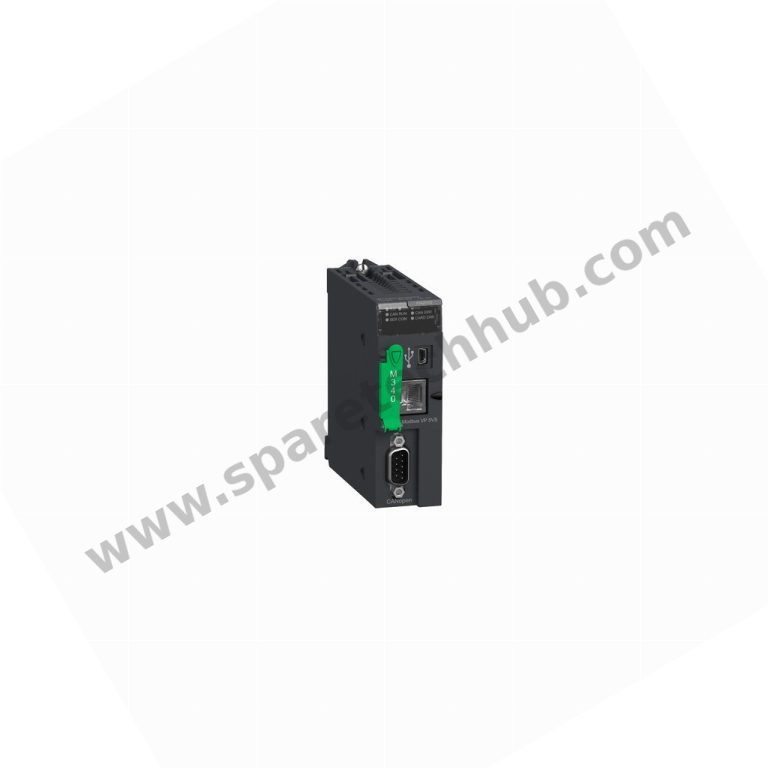
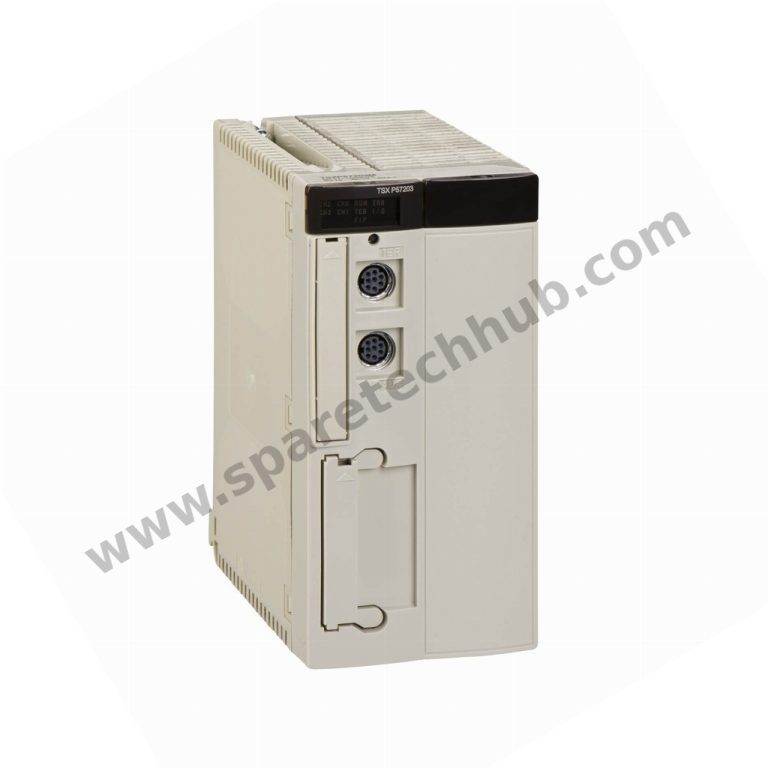
For a plant that buys automation spares rather than semiconductor reels, the consequence is simple: PLC availability is quoted per part number, not per brand. A logic solver or communication module in a mature family can sit at the 30-week end while a sibling in the same series ships in ten. Our PLC and controller stock is organised so buyers can see what is physically held today, family by family — for example Modicon X80 modules such as the Schneider Electric BMXDDI1604T 16-point digital input, legacy Modicon Quantum 140CRA93200 redundancy manager, and GE VersaMax IC200UDR005 28-point controllers. The Schneider Modicon 140 module guide covers how those generations differ when you are matching a replacement to an existing rack.
Industrial sensors: the 8–60 week spread
Sensors are the widest range in the report and the most commonly underestimated line in a spares budget. The qualifier “analog” matters. A digital or IO-Link sensor ships a decision; an analog device ships a measurement chain — sensing element, amplifier, compensation, filtering, output stage — and that chain depends on precision analog semiconductors that are low-volume, high-mix and factory-calibrated. Precision analog was one of the categories still tightening in distributor reporting through late 2026, and analog parts surveyed at 20–40 weeks do not translate into 8-week finished sensors.
Condition-monitoring hardware is the clearest example. A Bently Nevada 3300 XL 8 mm proximity probe is an analog transducer with a matched extension cable and calibration curve; probes, cables and monitors are held as graded stock across our proximity probe catalogue and the Bently Nevada brand index, with the Bently Nevada spare parts guide explaining which 3300 XL ordering blocks have to match to keep a calibrated channel valid.
Encoder and machine-vision lines behave the same way. The SICK DFS60B-S1MA10000 incremental encoder and CLV621-1120 linear barcode scanner sit in the same industrial sensors group as Keyence IV2 vision sensor heads, and the SICK sensors and encoders buying guide covers the part-number traps that turn a “simple sensor swap” into a second order.
HMIs and robots: 8–16 weeks is not “off the shelf”
Both categories share the same qualifier — SoM components — and the same price direction. Panel-builder HMIs are embedded computers: a system-on-module, a display, a resistive or capacitive front layer. Robot controllers and teach pendants use the same class of part. An 8–16 week range is comfortable for a planned upgrade and hopeless for a line-down failure on a Friday afternoon, which is exactly the situation most spare-parts decisions are actually made in.
Robotics pricing behaves differently from the rest of the report. ASC attributes the stable-to-decreasing trend to heavy capital investment, expanded production capacity and supplier competition — a supply-side story rather than a demand story. That is good news for new cells and neutral-to-bad news for anyone holding unsold inventory. Operator-interface and controller spares for robot and CNC installations are stocked under HMIs and touch panels and industrial robots, including FANUC units such as the A02B-0200-C081 operator interface panel and the A06B-0064-B203 AC servo motor listed against the FANUC brand page.
Drives and motion: the electromechanical exception
Drives are the only category in the report whose influencing factor is described as “general electromechanical trends” rather than a named component class, and the only one with a flat “stable” price call. That is consistent with the hardware: a variable-frequency drive is dominated by power semiconductors, capacitors, magnetics and a heatsink, and its control silicon is generally a lower-specification part than a PLC’s. The 8–52 week range is wide because drive families span both ends of the power curve — a 3 kW general-purpose unit and a multi-megawatt medium-voltage frame are not the same supply chain.
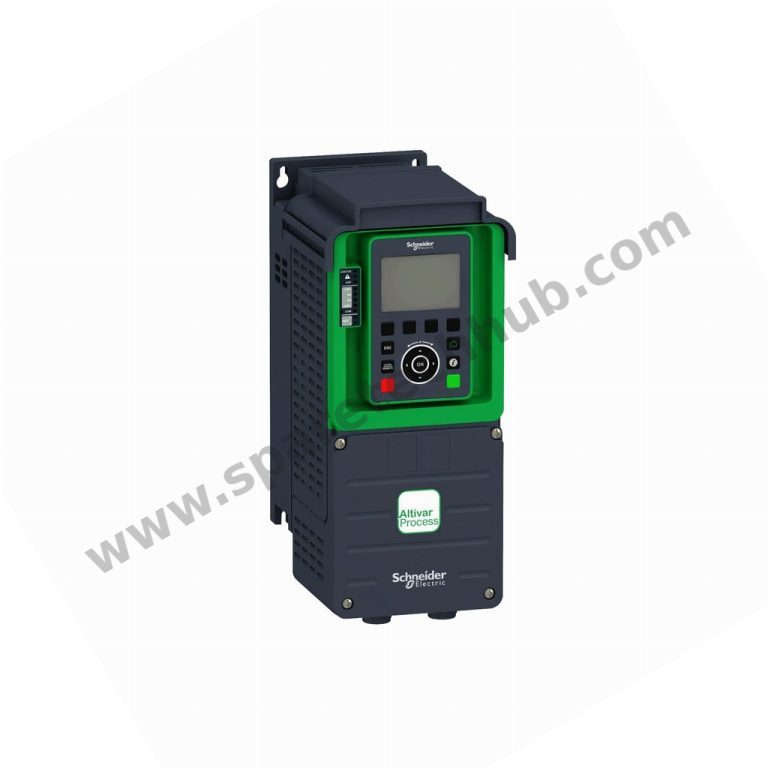
Motion hardware is where the MCU story returns, though: servo drives and servo amplifiers carry the same embedded controllers as PLCs. In-stock examples include the Schneider Altivar 610 ATV610U30N4 3 kW drive in our VFDs and inverters range, the Siemens SIRIUS 3RW4055-6BB44 75 kW soft starter under motor controls and soft starters, and servo motors and drives across the Schneider Electric and Siemens indexes. The Siemens SIRIUS 3RW soft starter guide sets out the rating and bypass variants that get confused on a purchase order.
End-of-life is the risk the lead-time table hides
Lead time is a schedule problem. Obsolescence is a “the part will not exist” problem, and the same report’s end-of-life section shows how many of those clocks are already running out. ASC’s published EOL entries, cross-checked against manufacturer notices, include the following.
| Component or software | Status and date | Manufacturer successor path |
|---|---|---|
| Siemens SIMATIC S7-300 CPUs and components | Type cancellation (PM410), 1 October 2025 | SIMATIC S7-1500 |
| Siemens SIMATIC ET 200M I/O system | Type cancellation (PM410), 1 October 2025 | ET 200MP / ET 200SP |
| Siemens S7-400 central signal modules | PM400 1 October 2025; PM410 1 October 2026 | ET 200MP / ET 200SP / ET 200SP HA |
| Allen-Bradley RSLogix 5 (for PLC-5) | New activations discontinued 31 December 2025 | Studio 5000 Logix Designer |
| ABB MS325 / MO325 motor protection | Obsolete status, July 2025 | Varies by region and model |
| Omron G8N series DC relays | Discontinued, September 2025 | G8NB series |
Siemens confirms the S7-300 and ET 200M dates directly: PM400 (end-of-production announcement) took effect on 1 October 2023 and PM410 (type cancellation) on 1 October 2025, after which the hardware is available only as a spare part and not for plant expansion. The S7-400 central signal modules reached PM400 on 1 October 2025 with PM410 on 1 October 2026 — a date that passed three weeks ago. Multiply a PM410 part by a 39-week component tail and you get the scenario that actually stops production: not a long quote, but a quote nobody will honour.
What a stabilising market changes about your spares strategy
Falling prices and shorter lead times tempt maintenance budgets back to just-in-time. Three data points argue for keeping some of the buffer.
1. Macro delivery performance is still slow, not fast. The Institute for Supply Management’s September 2026 manufacturing report showed a PMI of 54.5% with supplier deliveries at 59.0% — an index above 50% means deliveries are getting slower, not quicker — and average commitment lead times of 49 days for MRO supplies, 84 days for production materials and 176 days for capital expenditure. “Stabilised” means predictable, not instant.
2. Downtime inflation outruns general inflation. ASC’s analysis compares US inflation of about 19% between 2019 and 2023 with an 113% rise in the cost of an hour of downtime in automotive and a 319% rise in heavy industry. Insurance against a 100× worse event is not a comparable cost line to a part that has fallen 6% in price.
3. Cheaper hardware lowers the cost of holding stock, not the cost of waiting. A 6% price decline is a genuine reason to stop panic-buying at the top of a shortage cycle. It is not a reason to run a PM410 platform with zero spares. The rational move in a decreasing-price market is to buy the criticality list now, at a falling price, rather than to buy it later at a falling price under emergency conditions.
Concretely, that means: budget by component class rather than by catalogue average; run a last-time-buy decision on criticality × installed base × lead time rather than on the vendor’s EOL letter alone; qualify a surplus and refurbished channel before the first line-down call, including how parts are tested, how condition is graded and what warranty applies; match spares to lifecycle status so a shelf does not fill with modules for a platform being retired; and re-check the ordering blocks, because a matched part number is the difference between a swap and a second order.
Sources and further reading
- ASC Global — MRO & Industrial Automation Market Report (Q4 2025 edition): lead times, pricing trends, EOL entries, earnings recap and downtime-cost analysis.
- Siemens Industry Online Support: product phase-out notices for S7-300 / ET 200M and S7-400 central modules.
- Institute for Supply Management: ISM Manufacturing PMI Report, September 2026.
- Distributor component-market reporting for 2026 on MCU, analog and passive lead times, compiled by Future Electronics / Xinsanban (September 2026) and Songhall (August 2026).
- Related reading on this site: Siemens’ €1 billion industrial AI programme and what it means for spare parts, and the full guides index.
Frequently asked questions
What is the current lead time for PLCs?
ASC Global’s latest published MRO and industrial automation market report gives programmable logic controllers a range of 10–39 weeks, explicitly qualified as being driven by MCU availability. Average PLC pricing in the same report is decreasing, by about 6%.
Why are industrial sensors quoted at 8–60 weeks?
The 8–60 week band applies to analog sensors. An analog device contains a precision signal chain — sensing element, amplifier, compensation, filtering and output stage — built from low-volume, high-mix, factory-calibrated components, so its availability tracks the analog semiconductor market rather than general assembly capacity. Digital and IO-Link sensors with simpler signal chains normally sit at the short end of the range.
Are industrial automation prices falling in 2026?
Directionally, yes, in the categories ASC reports. PLC prices are decreasing by about 6% on average; robots, HMIs and sensors are all “stable to decreasing”; drives are the only category called flat “stable” on price. Component-level pricing is a different picture — MCU, power semiconductor, precision analog and MLCC quotations were still firm or rising in distributor reporting through late 2026.
What does PM410 mean for a plant running a Siemens S7-300?
PM410 is Siemens’ type-cancellation milestone. S7-300 CPUs, components and ET 200M hardware reached it on 1 October 2025, so they are now supplied only as spare parts for existing installations, in spare-part quantities, and are not available for plant expansion. Siemens nominates S7-1500, ET 200MP and ET 200SP as the functional replacements. Existing systems can keep running; the change is in how spares behave, which is why a stock review is more useful than an immediate migration.
Is it safe to buy surplus or refurbished automation parts when lead times are long?
It is safe when the supplier documents what was done to the unit. Ask for the condition grade, what functional tests were run and at what scope, whether the part number and revision match the installed unit exactly, and what warranty period applies. A graded, tested surplus part with a written warranty is a normal engineering answer to a 39-week new-buy lead time; an untested “as-is” listing at a low price is not.
How long should a critical spare be held for?
Hold it for the remaining service life of the machine, not for the remaining availability of the part. A drive or controller that reaches end-of-life in 2026 may still be commissioned on a line that runs to 2035, and after PM410 the supply route narrows to whatever the aftermarket holds. That is the point at which a documented condition grade and a tested shelf become the plant’s real insurance policy.
Talk to SpareTechHub
Need a specific part number checked against what is physically in stock, with a condition grade and a firm delivery date? Send us the model numbers from your machine register and we will quote within one business day.