Syria’s state electricity company and a Czech repair specialist have signed a rehabilitation contract for three of the five generating units at the Aleppo Thermal Power Plant. The agreement, signed in Damascus on 15 November 2026, covers units 2, 3 and 4, each rated at 213 MW, for a combined 639 MW. It is a phased, multi-year package, and it is separate from the work that returned units 1 and 5 to service earlier in 2026.
Most of the early coverage conflated the two projects. This article separates what the 15 November contract actually says from the earlier maintenance campaign, checks the capacity arithmetic against the plant’s nameplate rating, and sets out the engineering questions that matter when three long-idle 213 MW units are brought back.
TL;DR
- Who signed: the Syrian Electricity Company (SEC) and Czech firm Energy Care, at the Ministry of Energy in Damascus on 15 November 2026. SEC was represented by Aleppo plant director Imad Abu Ali; Energy Care by its Syria representative, Haitham Eid.
- What is covered: units 2, 3 and 4 only, at 213 MW each — 639 MW combined. Units 1 and 5 are outside this contract.
- Value: $93 million, according to Energy Minister Mohammad al-Bashir’s post on X as reported by SANA’s Arabic service. The English-language SANA report did not repeat the figure.
- Schedule: unit 3 is due back 18 months after work begins, unit 4 after 24 months and unit 2 after 30 months. Work on all three is described as simultaneous. Execution starts once the site has been prepared logistically.
- Capacity check: 639 MW plus roughly 400 MW from units 1 and 5 gives about 1,040 MW, which matches SANA’s post-project figure. The plant’s nominal rating is reported at 1,065 MW, or five units at 213 MW; the 25 MW difference is the shortfall in units 1 and 5, not a missing package.
- Scope correction: rotary air preheaters, forced-draft air systems and water treatment equipment were named in the earlier repairs to units 1 and 5, not in the 15 November contract.
- Not disclosed: an equipment-level work breakdown, contract terms, performance guarantees and a fixed mobilization date.
What did SEC and Energy Care actually sign?
They signed a rehabilitation agreement for the second, third and fourth generating units at the Aleppo Thermal Power Plant, with a combined design capacity of 639 MW. It is a rehabilitation and repair contract, not a new-build order, and it does not cover the whole station.
The signing took place at the Ministry of Energy building in Damascus, in the presence of Energy Minister Mohammad al-Bashir and the Czech Ambassador to Syria, Vítězslav Pivoňka. SANA identifies Imad Abu Ali, director of the Aleppo plant, as the signatory for SEC, and Haitham Eid, Energy Care’s representative in Syria, as the signatory for the contractor.
| Item | Verified detail |
|---|---|
| Buyer | Syrian Electricity Company (SEC) |
| Contractor | Energy Care, described by SANA and the Czech Embassy as a Czech company |
| Signed | 15 November 2026, Ministry of Energy, Damascus |
| Units covered | Units 2, 3 and 4 |
| Unit rating | 213 MW design capacity each |
| Covered capacity | 639 MW |
| Value | $93 million, per the energy minister’s post on X cited by SANA Arabic |
| Completion milestones | Unit 3: 18 months; unit 4: 24 months; unit 2: 30 months |
| Execution start | After the site is prepared logistically with equipment |
| Equipment-level scope | Not published in the official announcement |
Energy Care’s published profile is that of a repair and overhaul contractor, not an original equipment manufacturer. Its website describes generator and motor rewinding, transformer services, power-plant major overhauls and spare-parts supply, with a stated history back to 1989 and a subsidiary named Golden Power Elektrik Limited. That profile is useful context for the kind of work the contract can contain, but it is not a substitute for a published scope list.
Does the 639 MW figure cover the whole plant?
No. The contract covers three of the plant’s five units. Units 1 and 5 are excluded and are already contributing about 400 MW between them, which is why the post-project total is stated as roughly 1,040 MW rather than 639 MW.
According to the Arabic-language SANA report, unit 5 is producing 202 MW and unit 1 about 195 MW, for a current plant output of roughly 400 MW. The new contract therefore adds the output of units 2, 3 and 4; it does not replace or upgrade units 1 and 5.
| Unit | Design rating | Status in the 15 November contract | Contracted return |
|---|---|---|---|
| Unit 1 | 213 MW | Not covered; currently about 195 MW | — |
| Unit 2 | 213 MW | Rehabilitation | 30 months |
| Unit 3 | 213 MW | Rehabilitation | 18 months |
| Unit 4 | 213 MW | Rehabilitation | 24 months |
| Unit 5 | 213 MW | Not covered; currently about 202 MW | — |
| Covered total | 639 MW | Units 2–4 | 18–30 months |
How do 639 MW, 400 MW and 1,040 MW reconcile with a 1,065 MW plant?
The arithmetic is consistent. Three units at 213 MW make 639 MW. Units 1 and 5 currently deliver about 397 MW, so the post-project total is about 1,036 MW, rounded by SANA to roughly 1,040 MW. The plant’s nominal 1,065 MW rating assumes five units at 213 MW; the roughly 25 MW gap is the amount by which units 1 and 5 are currently below their design rating.
The distinction matters because 1,040 MW is a post-project operating estimate, not a new nameplate rating. If units 1 and 5 were later restored to their full 213 MW each, the station’s design total would return to 1,065 MW. Nothing in the 15 November announcement commits either party to that additional work.
Public references describe Aleppo as a five-unit steam station built under a turnkey contract of about 1,000 MW, with Mitsubishi Heavy Industries named as the turnkey supplier. A separate energy profile for Aleppo governorate gives 1,065 MW nominal and about 400 MW available at its September 2026 reference date.
Is 18–30 months the contract duration?
No. 18–30 months is the span of three unit-level completion milestones, not a single contract duration. Unit 3 is scheduled to return 18 months after work begins, unit 4 at 24 months and unit 2 at 30 months. SANA reports that work on all three units will proceed simultaneously.
The contractor’s representative said implementation begins once the site has been prepared logistically with all equipment and supplies. No calendar start date was announced, so the milestones should be read as months from mobilization rather than from the signing date. The 30-month figure is the last unit milestone, not necessarily the end of every warranty, documentation or performance-test obligation.
What work is actually in the contract scope?
The official announcements describe rehabilitation, maintenance and repair of the three units but do not publish an equipment-level work breakdown. There is no public confirmation that the contract includes boiler pressure parts, turbine internals, generator rewinding, DCS replacement or any specific auxiliary package.
This is the most important gap in the public record. A 213 MW steam unit is not a single repairable item; it is a chain of boiler, turbine, generator, condenser, feedwater, draft, air-preheater, water-treatment, electrical and control systems. The contract value and schedule tell you the size of the program, but they do not tell you which of those systems the contractor is obligated to restore, to what standard, or against what performance guarantee.
Energy Care’s own service list is broader than generator rewinding. It includes power-plant rehabilitation, major overhaul, transformer services, AC and DC rotating-machinery diagnosis, and spare-parts supply. That is a plausible capability set for a three-unit rehabilitation. It still does not establish that every one of those services is in this contract.
Were rotary air preheaters, forced-draft fans and water treatment part of this deal?
The public record attributes those items to the earlier repairs on units 1 and 5, not to the 15 November contract. SANA reported on 6 May 2026 that comprehensive repairs to units 1 and 5 addressed technical faults in main and auxiliary systems, including rotary air preheaters, forced-draft air systems and water treatment equipment. That work lifted combined output to about 400 MW.
The 15 November announcement covers units 2, 3 and 4 and does not repeat that equipment list. Treating the May scope as if it were the November scope is a factual error, and it changes the reader’s picture of what the new contract is buying. If rotary air preheaters, draft systems or water-treatment automation are also included in the new contract, the Ministry of Energy and Energy Care have not said so publicly.
The distinction is not pedantic. Work on two units establishes almost nothing about the condition of the other three. Different units have different operating hours, different outage histories and different auxiliary equipment. A water-treatment plant that supports the station may be common to all units, but the unit-specific air preheaters, fans, condensers and feedwater trains are not.
Why does auxiliary and control scope decide whether a unit returns?
A generating unit returns to service only when the whole chain is ready, not when the turbine or generator alone is ready. Boiler pressure parts, draft systems, air preheaters, feedwater pumps, condensers, cooling systems, water chemistry, electrical protection and control loops all have to pass their own checks before synchronization.
Long-idle units tend to fail commissioning on the parts nobody photographed for the announcement. A forced-draft fan that has sat without rotation may need bearing replacement and realignment. An air preheater can suffer corrosion and seal damage. Water-treatment resin may be exhausted, and the demineralization plant may be unable to support first fire. Control systems may be obsolete enough that spares cannot be bought, which turns a mechanical outage into a controls migration.
The contract’s equipment-level scope therefore determines the risk allocation. If the contractor is responsible for a system, it carries the condition risk and the spare-parts risk. If the owner retains a system, those risks sit with SEC. The announcement does not allocate them publicly.
What does recommissioning a long-idle 213 MW steam unit involve?
The work follows a staged sequence: condition assessment, overhaul or replacement of degraded equipment, electrical and control verification, water-chemistry readiness, then commissioning and performance acceptance. The steps below are general industry practice for a unit of this class; they are not a description of the signed scope.
1. Condition assessment before the outage plan is fixed
Boiler pressure parts, turbine internals, generator windings and insulation, main transformers and auxiliaries need a baseline before work is priced. Vibration history, oil analysis, insulation resistance and borescope findings determine whether an item is overhauled, repaired or replaced. For rotating machinery, proximity probes and seismic monitors are the usual evidence base; a Bently Nevada 3500/42 proximitor and seismic monitor is the kind of rack module that carries that data into the protection and monitoring system.
2. Rotating equipment and balance of plant
Forced-draft and induced-draft fans, air preheaters, feedwater pumps and their motors are the usual long-lead items. Bearing replacement, alignment, coupling inspection and impeller cleaning are routine; a fan drive that is being replaced rather than repaired needs a starting and control philosophy. A Schneider Altivar 610 400 kW drive is an example of the class of variable-frequency drive used on large auxiliary fans, and the SIRIUS 3RW soft-starter guide covers the alternative starting approach where a drive is not justified.
3. Electrical, protection and control
Generator protection, excitation, synchronization, breaker timing and trip tests have to be verified before first synchronization. On the control side, the installed DCS or PLC may be several generations old. A Siemens S7-400H synchronization submodule illustrates the kind of legacy platform that can be kept running, but only if spares and engineering support remain available. Where the platform is beyond support, the choice is migration rather than repair; the Modicon 140 module guide and the ABB Advant DCS spares guide show two common legacy control families that plants keep alive during a staged transition.
4. Water chemistry and water treatment
Before first fire, the demineralization plant, dosing systems and sampling points must be able to hold chemistry within limits. Conductivity, silica and dissolved oxygen are the parameters that decide whether the boiler is ready, and they depend on valves, instruments and controllers that may have been idle as long as the unit. A ABB V18345 electro-pneumatic positioner is the kind of final element that has to stroke correctly after a long outage, while a guided-wave radar level sensor is typical of the instrumentation used on tanks and treatment vessels.
5. Commissioning and performance acceptance
Hydro tests, steam blows, protection trip tests, synchronization and load tests come before commercial acceptance. Performance acceptance should measure output at reference conditions, heat rate, auxiliary power consumption, turbine vibration and boiler efficiency. Those tests are what convert a completed outage into a contracted capacity result.
Where do spares and control-system obsolescence bite?
The highest-risk items on a long-idle unit are usually the ones with no current production and no documented substitute. An installed-base audit, early long-lead procurement and a form-fit-function approval process are what keep those items from setting the completion date.
| Risk | Evidence to request | Practical mitigation |
|---|---|---|
| Obsolete DCS or PLC platform | Installed-base list, firmware versions, vendor lifecycle status | Stage the migration; keep a tested spare controller and a documented fallback |
| Long-lead turbine or generator parts | Lead-time quotes, repair-versus-replace assessment | Procure before the unit outage window; specify acceptance tests |
| Undocumented field modifications | As-built drawings, loop drawings, change history | Site survey and reverse engineering before design freeze |
| Water chemistry not ready | Layup records, resin condition, dosing-system test results | Clean and passivate; prove chemistry before first fire |
| Protection settings out of date | Relay settings, test records, coordination study | Protection audit and trip test before synchronization |
Two component-level examples show why this is not theoretical. Motor protection and switching gear are often replaced during a unit overhaul because the existing devices no longer have tested spares; a SIRIUS 3RV motor-protection breaker is representative of the low-voltage layer that has to be matched to the revised motor schedule. On the monitoring side, a 3300 XL 8 mm proximity probe is a consumable item that is frequently missing from old spares stock, and the Bently Nevada spare-parts guide is a useful checklist for the rack, probes and extension cables that a returning unit needs.
What should performance acceptance cover?
Acceptance should test the contracted capacity at agreed reference conditions, not just the fact that the unit can synchronize. Output, heat rate, auxiliary power, vibration and boiler efficiency are the usual guarantees; protection trip tests and control-response checks confirm that the unit can stay on load.
The reference conditions matter because a 213 MW rating is not achieved at every ambient temperature, cooling-water temperature or fuel specification. A test procedure should fix those conditions, define correction curves and state the tolerance. It should also define what happens if a unit passes its output test but misses heat rate, because the commercial remedy is different.
For a phased program, each unit needs its own acceptance gate. Unit 3 returning at 18 months does not validate unit 2 at 30 months, even if the units are nominally identical. Shared auxiliaries, common water treatment and common control systems can transfer risk between units, which is why the contract’s interface schedule is as important as its milestone dates.
What remains unverified?
Five items are not in the public record: the equipment-level scope, the contract terms, the exact mobilization date, any performance guarantees, and whether units 1 and 5 will receive further work. The capacity and schedule figures are verifiable; the engineering content of the contract is not.
- Equipment-level scope: no published breakdown by boiler, turbine, generator, auxiliary or control package.
- Commercial terms: payment schedule, penalties, warranty period and spare-parts obligations are not disclosed.
- Start date: the contractor says work begins after site logistics are ready, but no date is given.
- Performance guarantees: no public output, heat-rate or availability guarantee.
- Units 1 and 5: no announced follow-on work, despite the roughly 25 MW gap to their design rating.
Frequently asked questions
When was the Aleppo 639 MW rehabilitation contract signed, and by whom?
It was signed on 15 November 2026 at the Ministry of Energy in Damascus by the Syrian Electricity Company and Czech firm Energy Care. Aleppo plant director Imad Abu Ali signed for SEC, and Haitham Eid signed for Energy Care. Energy Minister Mohammad al-Bashir and Czech Ambassador Vítězslav Pivoňka attended.
Does the contract cover all five units at the Aleppo Thermal Power Plant?
No. It covers units 2, 3 and 4 only, with a combined design capacity of 639 MW. Units 1 and 5 are outside the contract and currently produce about 400 MW between them.
How can 639 MW plus 400 MW equal 1,040 MW when the plant is rated at 1,065 MW?
Three units at 213 MW make 639 MW. Units 1 and 5 currently deliver about 397 MW, so the post-project total is about 1,036 MW, rounded to roughly 1,040 MW. The 1,065 MW nameplate assumes all five units at 213 MW; the difference is the current shortfall in units 1 and 5, not an unaccounted package.
How long will the rehabilitation take?
The milestones run from 18 to 30 months after work begins: unit 3 at 18 months, unit 4 at 24 months and unit 2 at 30 months. SANA reports that the three units will be worked on simultaneously, so 18–30 months is a milestone range rather than a single contract duration.
Does the contract include rotary air preheaters, forced-draft fans and water treatment automation?
Those items were reported in the earlier repairs to units 1 and 5 in May 2026. The 15 November contract covers units 2, 3 and 4, and its official announcement does not publish an equipment-level scope. There is no public confirmation that the same auxiliary packages are included.
Is Energy Care an OEM, an EPC contractor or a repair company?
Its published profile is a repair and overhaul specialist: generator and motor rewinding, transformer services, major overhaul and spare-parts supply, with a stated history since 1989. The public record does not identify it as the original equipment manufacturer of the Aleppo units, and the announcement does not describe the contract as a turnkey new-build.
What should an operator verify before restarting a long-idle unit?
Verify the condition of boiler pressure parts, turbine internals, generator insulation, main transformers and auxiliary rotating equipment; confirm that protection settings and trip tests are current; prove water chemistry and treatment capacity before first fire; and define performance acceptance at reference conditions. Spares availability for obsolete controls should be settled before the outage window, not during commissioning.
Sources and verification
- SANA (English), “Syria signs deal with Czech firm to rehabilitate 639 MW at Aleppo power plant” — signing date, venue, signatories, units 2–4, 213 MW each, phased 18/24/30-month milestones, post-project ~1,040 MW, current ~400 MW, earlier units 1 and 5 work.
- SANA (Arabic), “اتفاقية بين السورية للكهرباء وشركة تشيكية لتأهيل 3 مجموعات بمحطة حلب الحرارية” — $93 million value from the energy minister’s post on X, simultaneous work, execution after site logistics, unit 5 at 202 MW and unit 1 at about 195 MW.
- Energy Care Group and company profile — Czechia-based repair, rewinding, overhaul and spare-parts capability; Golden Power Elektrik Limited subsidiary; history since 1989.
- Embassy of the Czech Republic in Damascus — Vítězslav Pivoňka as Czech Ambassador to Syria.
- PGESCo, Syria project reference — Aleppo described as a five-unit steam plant with 200 MW-class units.
- EC Group, The Aleppo Thermal Power Station — Mitsubishi Heavy Industries turnkey reference for a station of about 1,000 MW.
- Aleppo Energy Profile — nominal capacity 1,065 MW; available capacity about 400 MW at the September 2026 reference date.
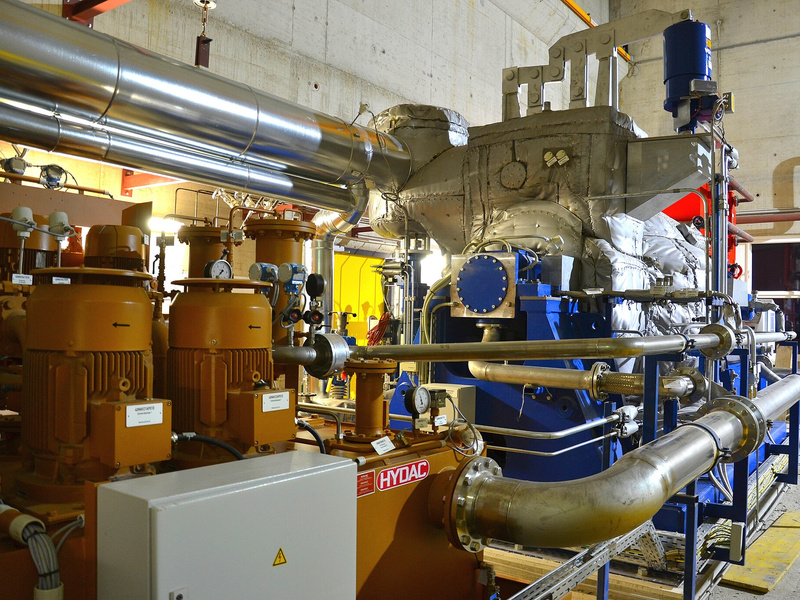
Image: steam turbine and lube-oil auxiliary skid at a thermal power station (illustrative, not the Aleppo plant).