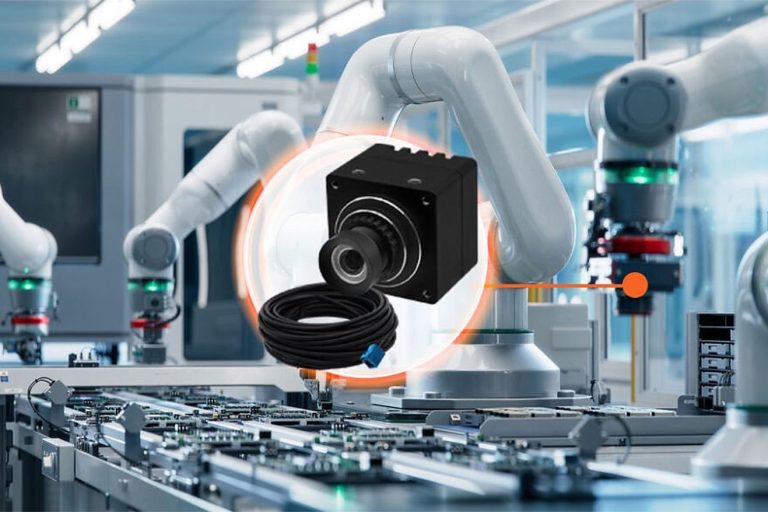
Beijer Electronics announced the Nexto XF on 2 October 2026. It is a modular PLC platform that runs CODESYS control applications and Docker containers natively on an embedded Linux environment. The pitch is straightforward: keep the deterministic IEC 61131-3 loop a machine needs, and add the tooling that IT and data teams expect — VPN, a firewall and web visualisation — without bolting a separate industrial PC onto the cabinet.
Beijer is not one of the brands we stock. We cover the surrounding cabinet hardware from Schneider Electric, GE, Allen-Bradley and Siemens, and this guide is written for the buyer who has to decide whether the XF belongs in a new design, an edge retrofit or a distributed control architecture. Below is what Beijer actually published, the model differences that matter at order time, and the questions the catalogue does not answer.
In Short: What Beijer Announced
- Announcement: Beijer published the Nexto XF on 2 October 2026 as a modular PLC for machine builders, system integrators and demanding industrial applications.
- Five CPUs: BCS-XF300-B, BCS-XF300, BCS-XF315, BCS-XF325 and BCS-XF325-W, with part numbers from 66.018.120-6 to 66.018.124-9.
- Control engine: CODESYS 3.5-based BCS Tools, with IEC 61131-3 languages ST, LD, SFC, FBD and CFC.
- Linux and Docker: Beijer lists a Linux environment that runs Docker and CODESYS applications natively, with 2.5 GB of user-file memory shared by the CPU and Docker environment.
- Performance claim: up to 1,000 PID loops in less than 2 ms. Beijer does not publish the benchmark conditions behind that figure.
- Security: built-in firewall, web server diagnostics and secured remote access by VPN. The XF325-W adds WebVisu.
- I/O: every model has 16 digital inputs (9 fast), 16 digital outputs (8 fast), two Ethernet ports, RS-485, CAN and USB. The XF315 adds 10 analog inputs; the XF325 adds 10 analog inputs and 2 analog outputs.
- Fieldbuses: EtherCAT master, PROFINET controller, EtherNet/IP scanner/adapter, Modbus TCP and Modbus RTU, OPC UA/DA server, MQTT client, CANopen master and J1939.
- Environment: 24 Vdc, IP20, −20 to 60 °C, conformal coating, CE, UL, cUL and DNV. No SIL or PL safety rating is listed in the XF catalogue data.
What the Nexto XF Actually Is
The Nexto XF is Beijer’s answer to a design problem that has become common in machine building: the control loop belongs in a PLC, but the data, connectivity and remote-access functions increasingly belong in a Linux computer. Instead of adding a second box, the XF puts both roles on one controller. Beijer positions it as a standalone edge controller or as part of a distributed automation architecture with remote I/O and data processing.
Beijer calls the platform modular. The public catalogue lists five CPU variants with onboard I/O, and the platform can work with remote I/O over the fieldbuses it supports. If your design assumes a particular backplane, slice I/O family or migration path from an existing Nexto rack, verify that with Beijer rather than inferring it from the word modular. The catalogue pages we reviewed do not publish a compatibility matrix.
The engineering environment is BCS Tools, Beijer’s CODESYS 3.5-based platform. It covers development, debugging, configuration, simulation and commissioning in one tool, and it is available in Lite, Basic, Professional and Advanced licence levels. The XF supports online changes, a watchdog and a real-time clock, so it behaves like a conventional IEC 61131-3 controller from the programming seat. The difference appears when you look at what else runs on the same Linux host.
The Five BCS-XF Models Compared
The model suffix is not cosmetic. It changes the analog I/O, the symbolic memory and, in two cases, the fieldbus role and the visualisation licence. The table below uses Beijer’s published data for each CPU.
| Model | Part number | Digital I/O | Analog I/O | Symbolic variables | WebVisu | Fieldbus profile | Best fit |
|---|---|---|---|---|---|---|---|
| BCS-XF300-B | 66.018.124-9 | 16 DI (9 fast), 16 DO (8 fast) | None | 10 MB | No | EtherNet/IP Adapter only | Device-side EtherNet/IP node with a fixed, simple function set |
| BCS-XF300 | 66.018.121-4 | 16 DI (9 fast), 16 DO (8 fast) | None | 10 MB | No | EtherCAT, PROFINET, EtherNet/IP Scanner/Adapter, Modbus TCP/RTU, OPC UA, MQTT, CANopen/J1939 | General machine control without analog signals |
| BCS-XF315 | 66.018.122-2 | 16 DI (9 fast), 16 DO (8 fast) | 10 AI | 10 MB | No | Same as XF300 | Machines with analog sensing but no analog output |
| BCS-XF325 | 66.018.120-6 | 16 DI (9 fast), 16 DO (8 fast) | 10 AI, 2 AO | 32 MB | No | Same as XF300 | Closed-loop analog control with more symbolic memory |
| BCS-XF325-W | 66.018.123-0 | 16 DI (9 fast), 16 DO (8 fast) | 10 AI, 2 AO | 32 MB | Yes | Same as XF300 | Local web HMI without a separate panel |
Two differences deserve attention at quotation stage. First, the XF300-B is an EtherNet/IP Adapter, not a scanner. If the controller has to initiate connections to remote EtherNet/IP devices, the XF300-B is the wrong variant. Second, WebVisu is explicit on the XF325-W. Beijer’s platform page lists web visualisation as a family capability, but the model-level page for the XF325 does not add WebVisu to the order description. Confirm the visualisation licence on the exact model you buy.
All five CPUs share the same core allocation: 32 MB program memory, 128 KB retain/persistent memory, 256 MB source-code backup, 16 tasks, 2 × RJ45 Ethernet at 10/100 Mbps, one RS-485 port, one CAN port and one USB host port. The shared I/O count is useful for panel layout, but it also means the XF is not a high-channel-count rack controller on its own; remote I/O is the expansion path.
CODESYS, Linux and Docker: How the Three Layers Fit
It helps to separate the XF into three layers, because each one has a different real-time and lifecycle contract.
Layer 1: the IEC 61131-3 control task
CODESYS runs the control application. The XF supports ST, LD, SFC, FBD and CFC, online changes, a watchdog and 16 tasks. This is the layer that owns scan time, I/O refresh and the deterministic behaviour of the machine. Treat it as the hard real-time core, even if Beijer does not publish a jitter figure for the platform.
Layer 2: the embedded Linux host
Linux provides the services around the runtime: networking, the web server, VPN, firewall rules and the container engine. Beijer describes the environment as Linux with native Docker and CODESYS support. The practical consequence is that the controller can host software that would otherwise need a separate edge gateway, but it also inherits the patch, account and configuration discipline of a Linux system.
Layer 3: Docker containers
Containers are the right place for non-deterministic work: protocol conversion, MQTT or Sparkplug B gateways, local dashboards, log shipping, lightweight analytics, image pre-processing and edge buffering. They are the wrong place for the emergency-stop logic, the motion loop or anything that must keep a guaranteed cycle through a container restart. Docker documents the isolation model clearly; it is process and filesystem isolation, not a real-time guarantee.
Three resource facts matter. The XF has 2.5 GB of user-file memory shared by the CPU and Docker environment; that is storage for images, logs and application files, not a promise of 2.5 GB of RAM. The symbolic-variable memory is 10 MB on the XF300 and XF315, and 32 MB on the XF325 and XF325-W. And Beijer notes that BCS-XF uses CODESYS ABL licensing at certain licence levels, with I/O channel and communication-tag usage reported in the Software Metrics window. Ask for the licence level and the channel/tag limits in writing before you standardise a large project on the platform.
Security: VPN, Firewall and Web Visualisation
The XF family lists a built-in firewall, web server diagnostics and secured remote access by VPN. The XF325-W adds WebVisu. The operational benefit is real: a service engineer can reach the machine through one controller instead of a separate VPN router, and the same box can serve diagnostic pages and a local web HMI.
The public data sheet stops short of the details a security reviewer will ask for. It does not publish the VPN protocol or encryption suite, firewall throughput and rule capacity, authentication model, role separation, certificate lifecycle or secure-boot support. Those are not reasons to reject the platform; they are reasons to request the security configuration guide and test the answers against your own standard, such as NIST SP 800-82 for operational technology or IEC 62443 for industrial automation and control systems.
A built-in firewall is a control, not a substitute for network segmentation. In a plant design, put the XF on an OT VLAN, deny inbound traffic by default, allow the specific engineering and data flows the application needs, and use the VPN for remote support rather than exposing the web server to the internet. Change default credentials, centralise logs, back up the configuration and test the restore. IP20 and a conformal coating protect the electronics from the cabinet environment; they do not protect the controller from a flat network.
I/O and Communication: What Connects Where
The onboard I/O is fixed per model, so the first design decision is whether the machine needs analog signals at the controller or at remote I/O. The XF300 and XF300-B have no analog channels. The XF315 adds 10 analog inputs. The XF325 and XF325-W add 10 analog inputs and 2 analog outputs. Every model keeps the same 16 digital inputs and 16 digital outputs, with nine fast inputs and eight fast outputs for counter, PTO and PWM functions.
| Onboard function | Published specification |
|---|---|
| Digital inputs | 16, opto-isolated, sink/source, 24 Vdc, 2 ms response, 2–255 ms software filter |
| Digital outputs | 16, opto-isolated transistor source, 1.5 A per output, 6 A total, 250 Hz maximum switching frequency |
| Analog inputs | 10 on XF315/XF325/XF325-W, 12-bit, 0–10 V or 0/4–20 mA, individually configurable |
| Analog outputs | 2 on XF325/XF325-W, 12-bit, 0–10 V or 0/4–20 mA, individually configurable |
| Ethernet | 2 × RJ45, 10/100 Mbps, 100 m maximum cable length |
| Serial | 1 × RS-485, Modbus RTU master/slave or open protocol, up to 115,200 bps |
| CAN | 1 × CAN, CANopen master and J1939 manager, up to 64 nodes |
| USB | 1 × USB 2.0 host, Type-A |
The protocol list is broad for a controller this size: EtherCAT master, PROFINET controller, EtherNet/IP scanner/adapter, Modbus TCP client/server, Modbus RTU master/slave, OPC UA/DA server, MQTT client with Sparkplug B, CANopen master, J1939, HTTP server, SNTP client and SNMP agent. That makes the XF a plausible data concentrator as well as a machine controller. Two omissions are worth noting. There is no PROFIBUS DP port and no CC-Link IE fieldbus in the published XF data; if the installed base uses either, plan a gateway or keep the existing controller. And the Ethernet ports are 10/100 Mbps, not gigabit, so size vision, historian or large-file traffic accordingly.
Performance and Determinism: Reading the 1,000-PID Claim
Beijer’s headline is up to 1,000 PID loops in less than 2 ms. That is a vendor claim, not a specification of your application. The number will move with loop complexity, the number of I/O points refreshed in the task, the task period, communication load and whatever containers are running on the same CPU. Beijer does not publish the benchmark code, the task configuration or the jitter distribution behind the figure.
The useful response is to treat 1,000 PID loops as a ceiling for a favourable benchmark, then run a pilot with your own control code. Measure the worst-case cycle, not the average. Keep the control task and the container workloads separated by design: pin the control task to the resources it needs if the runtime exposes that control, cap container CPU and memory, and monitor for latency spikes during image pulls, log rotation and container restarts. If the application depends on tightly synchronised multi-axis motion over EtherCAT, ask Beijer for axis-count and cycle-time evidence; the PID benchmark does not answer that question.
Environmental and Certification Fit
The XF is a cabinet controller, not a field device. The published ratings are IP20, −20 to 60 °C operating, −40 to 70 °C storage, 10–95% relative humidity non-condensing, and 24 Vdc nominal input with an 18–30 Vdc range. Power dissipation is listed at 10 W. The module measures 112.2 × 122.8 × 123.0 mm and weighs 513.5 g. Conformal coating is standard, which helps in humid, corrosive or dusty cabinet environments, but it does not make the controller washdown-rated or suitable for direct outdoor mounting.
Certifications are CE, UL, cUL and DNV, with IEC 61131-2, EMC and Low-Voltage Directive compliance. The DNV mark is notable for marine and offshore panel builders. The catalogue data we reviewed does not list SIL or PL safety certification. If the machine needs a safety function, use a certified safety controller or safety relay and keep the XF on the standard-control side of the architecture.
Where the Nexto XF Fits, and Where It Does Not
The XF makes most sense where a machine or remote asset needs both deterministic control and local data processing, and where the cabinet has room for one Linux-based controller instead of a PLC plus an edge PC. Typical fits are OEM machines with CODESYS-standardised engineering, skid-mounted equipment, marine and offshore panels, remote pumping or energy sites, and plants that want OPC UA or MQTT data without a separate gateway.
It is a weaker fit in four cases. It is not a drop-in replacement for an existing Nexto rack until Beijer confirms I/O and project compatibility. It is not a safety controller. It is not a high-axis-count motion controller until EtherCAT cycle and axis limits are proven on your application. And it is not a plant-wide historian; containers can buffer and forward data, but long-term storage belongs on a server with the retention and backup policy the plant already manages.
What It Changes for Spares and Lifecycle Planning
The XF was announced in October 2026, so the installed base is young and the independent spares market has not built up around it yet. That changes the spare-parts plan in two ways. First, the hardware spare should be a complete, tested CPU of the exact model, because a lower variant may not have the analog channels or the WebVisu licence the application uses. Second, the software spare is now part of the bill of materials: the BCS Tools project archive, the runtime and firmware versions, the licence keys, the Docker images and compose files, the network and firewall configuration, and a written restore procedure.
For the cabinet around the controller, the parts are conventional. If you are keeping a mixed PLC estate running, our PLC and controller spares include the Schneider TM258LF42DT logic controller, the TM258LF66DT4L, the TM218LDA40DR4PHN, the Modicon Quantum 140CPU31110 and the GE VersaMax IC200UDR005. For analog and digital expansion, we stock the BMXAMI0410 analog input module, the TM3TI4 analog input module, the 140ACI05100SC 32-point input module and the 140AVO02000C analog output module.
On the network layer, the BMENOC0311 communication module, the BMENOS0300 switch module and the TCSESM083F2CU0 ConneXium switch cover the common Schneider architectures; the industrial networking category lists the rest. For power and local operation, see the BMXCPS2000 power supply module and the GE QuickPanel IC754VSI12CTD-HH, or browse the power supplies and HMIs and touch panels categories. If your line is also waiting on new stock, our 2026 PLC lead-time guide and 1756-L71 sourcing guide explain how we read the current market.
Beijer is not in our stocked brand list. If you need a specific BCS-XF part number, send it with the quantity and the required condition; we will review sourcing rather than promise stock we do not hold.
How to Specify a Nexto XF System
- Count the I/O, not just the channels. Decide whether analog signals land on the CPU or on remote I/O. That choice selects the XF300, XF315, XF325 or XF325-W before any other option is discussed.
- Check the fieldbus role. The XF300-B is an EtherNet/IP Adapter only. If the controller must scan remote EtherNet/IP devices, start at the XF300.
- Confirm the visualisation licence. WebVisu is explicit on the XF325-W. Do not assume it is included on every family member.
- Size the container workload. List every image, its memory and storage footprint, its restart behaviour and its network access. Keep the control task out of the container.
- Design the network zones. Put the controller on an OT VLAN, define the allowed flows, terminate remote access at the VPN and log the firewall events.
- Confirm the environment and certification. IP20 and conformal coating suit a cabinet, not a washdown area. Check the DNV, UL and cUL documents against the panel certification file.
- Write the software spare plan. Freeze the BCS Tools project, runtime, licence, container images and configuration, and store an offline copy with the hardware spare.
Sources and Further Reading
- Beijer Electronics: Meet Nexto XF, 2 October 2026
- Beijer Electronics: Nexto XF modular PLC product page
- Beijer Electronics: BCS-XF325 technical data
- Beijer Electronics: BCS Tools, the CODESYS 3.5-based engineering platform
- Docker: overview of containers and isolation
- NIST SP 800-82 Rev. 3: Guide to Operational Technology Security
Specifications verified against Beijer’s public product pages on 2 November 2026. The 1,000-PID figure is Beijer’s published claim; it is not an independent benchmark.
Need the cabinet hardware around a Nexto XF design? Send your part list, including the exact BCS-XF model and any adjacent I/O, networking or power modules, to our team for a stock and sourcing check. We reply within one business day.
Frequently asked questions
What is the Beijer Nexto XF?
The Nexto XF is a modular PLC platform from Beijer Electronics, announced on 2 October 2026. It runs CODESYS control applications and Docker containers natively on an embedded Linux environment. Beijer positions it for machine builders and system integrators that need deterministic control plus edge computing in one cabinet device.
Which CODESYS version does Nexto XF use?
Beijer programs the Nexto XF with BCS Tools, its CODESYS 3.5 based engineering platform. BCS Tools supports IEC 61131-3 languages including ST, LD, SFC, FBD and CFC. The public product pages do not state the exact runtime version or licence level, so confirm both in the quotation.
Can Nexto XF run Docker containers?
Yes. Beijer lists native Docker support on the Nexto XF and allocates 2.5 GB of user file memory to the CPU and Docker environment. Containers are suitable for gateway, dashboard, logging and analytics workloads. Keep the IEC 61131-3 control task isolated from container workloads and validate jitter on your own project.
Does Nexto XF include VPN and firewall?
Yes. Beijer lists a built in firewall, web server diagnostics and secured remote access by VPN across the Nexto XF family. The public data sheet does not publish VPN protocols, firewall rule limits or authentication details. Request the security configuration guide before you expose the controller outside the plant network.
What is the difference between BCS-XF300, XF315, XF325 and XF325-W?
All four share 16 digital inputs, 16 digital outputs, two Ethernet ports, RS-485, CAN and USB. The XF300 has no analog I/O. The XF315 adds 10 analog inputs. The XF325 adds 10 analog inputs and 2 analog outputs. The XF325-W adds WebVisu. The XF300-B is a separate variant with EtherNet/IP Adapter connectivity only.
Is Nexto XF a safety PLC?
No. The Nexto XF catalogue data lists CE, UL, cUL and DNV certification, but it does not claim SIL or PL safety certification. Use a dedicated safety controller or safety relay for emergency stops, guarding and other safety functions.