Omron has agreed to buy OnLogic, the Vermont-based maker of rugged industrial computers, for $675 million in enterprise value. The deal was announced on October 13, 2026 and signed three days earlier. It is the clearest signal yet that the line between automation hardware and industrial IT is disappearing.
For plant engineers and maintenance teams, the acquisition matters less as a corporate finance story and more as an architecture story. Omron already sells the sensors that collect machine data, the controllers that decide what to do with it, and the robots and servos that act on those decisions. What it did not own was the fanless, wide-temperature computer that sits between the machine and the cloud, runs inference on the line, and keeps working when the network drops.
OnLogic fills that gap. The company designs and manufactures configure-to-order industrial PCs and ships them direct to customers from its base in South Burlington, Vermont. Omron says the two businesses will combine OnLogic computing platforms with Omron sensing, control, motion, robotics and safety products to build what it calls a physical AI platform.
This article breaks down the deal structure, the price, the technology fit, the risks, and what it means for anyone maintaining OnLogic hardware or building an edge layer around Omron controls.
The deal at a glance
| Item | Detail |
|---|---|
| Acquirer | Omron Corporation, headquartered in Kyoto, Japan |
| Target | Interlogic, Inc., parent of OnLogic, Inc., based in South Burlington, Vermont |
| Announcement | October 13, 2026; definitive agreement signed October 10, 2026 |
| Structure | Reverse triangular merger through a newly formed US subsidiary; Interlogic survives as a direct wholly owned subsidiary of Omron, and OnLogic becomes an indirect subsidiary |
| Enterprise value | $675 million, cash-free and debt-free |
| Consideration | All cash, funded primarily from Omron’s own funds |
| Expected close | Around January 2027, subject to regulatory approvals and customary conditions |
| Target FY2025 revenue | $154.2 million, up $32 million year on year |
| Target FY2025 adjusted EBITDA | $27.1 million |
| Footprint | About 300 employees, 160 of them in Vermont; 7 operating sites including 2 manufacturing sites |
| Advisors | Houlihan Lokey for Omron; Evercore for the seller |
What exactly is Omron buying?
Omron is not buying a generic box-PC assembler. It is buying a company that has spent more than two decades turning Intel and AMD platforms into machines that survive dust, vibration, heat, cold and 24/7 duty cycles.
OnLogic was founded in 2003 and now operates from seven sites, including two manufacturing locations, with offices in the United States, the Netherlands, Taiwan and Malaysia. The company says it serves more than 70,000 customers. Its revenue is heavily concentrated in the Americas and Europe, which together account for more than 90% of sales. That geographic mix is strategically useful to Omron, which has a much larger presence in Asia and sees North America as a key growth market.
The product portfolio covers several distinct layers of the edge:
- Karbon 520 series. Ultra-rugged fanless systems built around Intel Core Ultra processors with an integrated NPU, up to 96 GB of DDR5 memory, optional NVIDIA MXM graphics, an operating range of -40 to 70 degrees Celsius, and MIL-STD-810H testing. ModBay expansion modules add serial, CAN bus or extra Ethernet ports, and vehicle ignition power makes the same unit usable on mobile equipment.
- Karbon 800 series. A larger fanless platform with 12th Gen Intel Core processing, dual ModBay bays, PCIe Gen 4 expansion and extended-temperature operation for heavier I/O and storage loads.
- Helix family. More compact industrial computers, including the Helix 500, 511, 600 and the low-profile Helix 320, positioned for space-constrained cabinets and distributed applications.
- Panel PCs. Integrated display-and-compute units up to 24 inches, with stainless and IP-rated front bezel options for washdown and hygienic environments.
The commercial model matters as much as the hardware. OnLogic configures systems to order and sells direct, which shortens the path from a specification to a shipped unit. For an automation vendor, that model is a template for how to deliver a compute layer without holding finished-goods inventory for every possible configuration.
Why does an automation company need an industrial PC maker?
Omron’s own explanation centers on three objectives. First, combine OnLogic industrial PCs with Omron high-precision control technology to accelerate development of a next-generation physical AI platform. Second, use each company’s sales channels to cross-sell into markets where the other is stronger. Third, integrate Omron sensors and robots with OnLogic computers to develop joint solutions for digital transformation on the factory floor.
The strategic frame is Omron’s SF2030 long-term vision and its GEMBA DX program, which translates roughly to digital transformation of the actual place where work happens. Omron CEO Junta Tsujinaga has described the investment as a step toward that vision and toward a manufacturing model built around physical AI, where machines sense, decide and act with less human intervention.
That is a meaningful shift in identity. Omron built its reputation as a factory automation equipment maker: photoelectric sensors, safety light curtains, PLCs, motion controllers, servo systems, SCARA and delta robots. In a physical AI world, the value does not sit only in the device that closes a contact or turns a shaft. It also sits in the layer that aggregates data from dozens of those devices, runs a vision model or a predictive-maintenance model locally, and sends only the conclusions upstream.
Buying that layer is faster than building it. Omron already has an industrial PC line, the NY series, but it is tightly coupled to Omron’s own control ecosystem. OnLogic brings a broad, vendor-neutral x86 platform business with configurable I/O, GPU and NPU options, a direct sales motion and customers outside Omron’s traditional base. The two lines will need clear segmentation, but they do not duplicate each other exactly.
Where does the edge computer sit in the control architecture?
The simplest way to understand the deal is to draw the stack in four layers. Omron is strong in three of them. OnLogic supplies the fourth.
| Layer | Job | Typical hardware | Who brings it |
|---|---|---|---|
| Sense | Convert physical state into signals: presence, position, temperature, force, images | Photoelectric and proximity sensors, vision systems, safety light curtains, encoders | Omron |
| Control | Run deterministic logic, motion profiles and safety functions in real time | PLCs, motion controllers, servo drives, safety controllers | Omron |
| Compute | Aggregate data, translate OT protocols, run AI inference, buffer and pre-process data, host local dashboards | Fanless industrial PCs and edge servers with CPU, NPU or GPU acceleration | OnLogic |
| Act | Move, position, grip, weld, inspect or reject | SCARA and delta robots, servo motors, actuators | Omron |
The economic argument for putting compute at the machine is latency and bandwidth. A deterministic control loop cannot wait on a distant data center, and a vision system that inspects every part cannot ship every frame to a public cloud. Inference has to happen close enough to the camera or the drive that the result arrives before the next cycle. The same logic applies to data sovereignty, offline operation and network cost.
This is also where the acquisition becomes commercially interesting. A plant that already runs Omron controls can add an OnLogic unit without introducing a new automation vendor. The IPC can speak to the control layer over Modbus TCP, EtherNet/IP or OPC UA, depending on the software stack, and can present a single data model to the IT side. That is the practical definition of OT/IT convergence: not a slogan, but a box in the cabinet that both sides can reach.
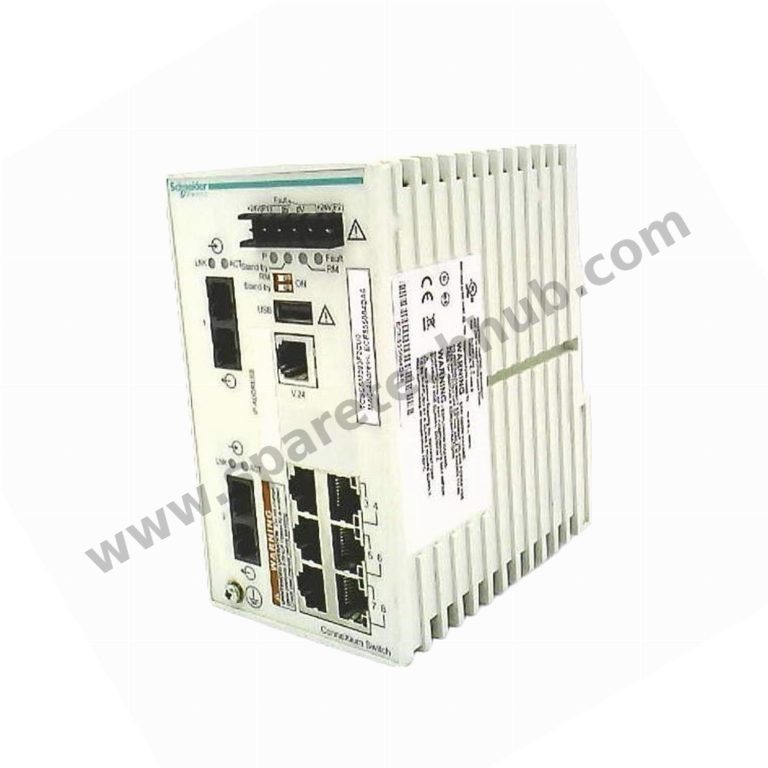
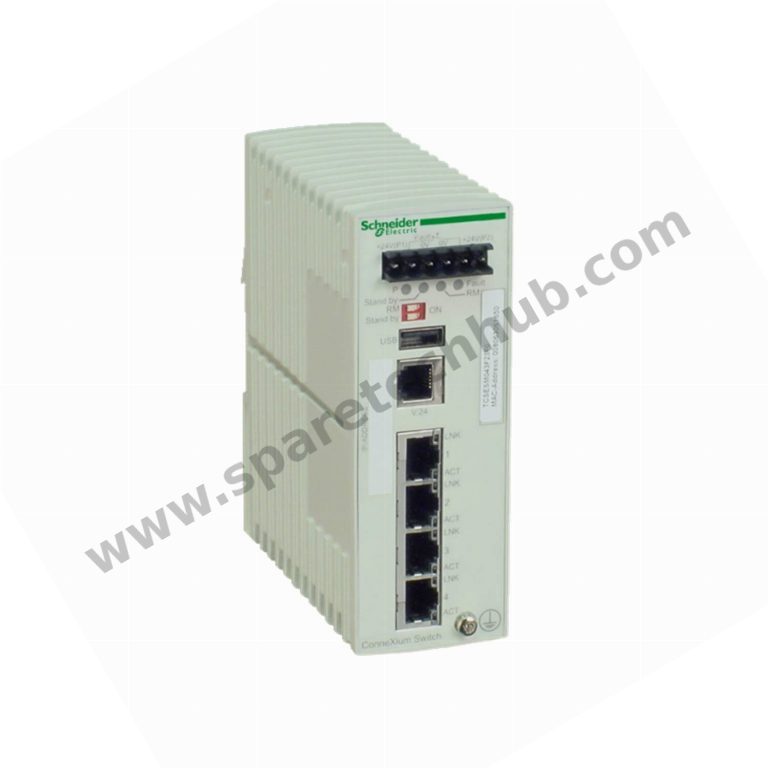
For the surrounding network, the choice of switch is as important as the choice of computer. A managed switch such as the Schneider Electric TCSESM083F2CU0, which provides six copper ports and two multimode fiber ports, can segment the cell network and carry edge traffic without exposing the control VLAN. Sites with long cable runs between buildings often use the single-mode variant, the TCSESM083F2CS0. Smaller cells can use an unmanaged eight-port switch or a four-port managed unit, both listed in the table below. More options are in our industrial networking category.
Is $675 million a high price?
On the numbers, Omron is paying a growth multiple rather than an asset multiple.
| Metric | Value | How it is calculated |
|---|---|---|
| Enterprise value | $675.0 million | Announced deal value, cash-free and debt-free |
| FY2025 revenue | $154.2 million | Reported by the seller |
| EV / revenue | 4.4x | 675 / 154.2 |
| FY2025 adjusted EBITDA | $27.1 million | Reported by the seller |
| EV / adjusted EBITDA | 24.9x | 675 / 27.1 |
| Adjusted EBITDA margin | 17.6% | 27.1 / 154.2 |
| Implied FY2024 revenue | About $122.2 million | 154.2 minus the $32 million increase |
| Revenue growth | About 26% | 32.0 / 122.2 |
| Enterprise value per employee | About $2.24 million | 675 / about 301 employees |
| Yen equivalent | About 104.6 billion yen | At 155 yen per US dollar |
A 24.9x EBITDA multiple prices in growth and strategic value, not just current cash flow. The revenue multiple of 4.4x is easier to defend for a business growing around 26% a year with a 17.6% adjusted EBITDA margin. The interesting question is what Omron expects beyond the standalone business: cross-sell into its installed base, supply-chain leverage, and a faster route to bundled physical AI offerings. Those synergies have to show up in Omron’s forward numbers, because they are already in the price.
It is also worth noting what the deal is not. It is not a distressed acquisition of a struggling hardware vendor. OnLogic is profitable, growing and has a direct customer base. Omron is buying capability and reach, and it is paying for both.
What changes for existing OnLogic customers?
On day one, very little. Omron has said OnLogic will operate as an independent business within the group, keeping its brand, its direct sales model, its global offices and its management team, including CEO Sean Larkin. No plant closures or product discontinuations were announced with the deal.
Over the following 12 to 24 months, the changes are more likely to appear in commercial packaging than in the hardware itself. Expect joint reference architectures that pair OnLogic systems with Omron controllers, sensors and robots. Expect Omron’s Asia-Pacific channel to get access to OnLogic products, and OnLogic’s North American and European customer base to be exposed to Omron automation. Expect supply-chain and logistics integration, which could shorten lead times in some regions and complicate them in others during the transition.
The risk for existing customers is not that the product suddenly changes. It is that attention shifts. When a small company is absorbed into a large one, the support portal, the firmware cadence, the warranty administration and the end-of-life process can all move without the hardware changing at all. Those are the things to document before the close.
What are the risks?
Channel conflict. OnLogic sells direct. Omron sells through distributors and system integrators. Keeping both models intact is easier to announce than to operate, especially when a joint bundle reaches the same end customer through two routes.
Portfolio overlap. Omron already sells NY-series industrial panel and box PCs. OnLogic’s broad, vendor-neutral x86 range overlaps at the edges. Omron will need a clear rule for when a customer should get an NY unit and when an OnLogic unit is the better fit.
Integration without integration. Promising independence protects the culture and the direct sales motion, but it also limits how quickly the two product roadmaps can converge. The synergies in the deal thesis depend on cooperation that the structure does not guarantee.
Execution against a growth multiple. At 24.9x adjusted EBITDA, the deal needs sustained double-digit growth and visible cross-sell. A slowdown in industrial capex would make the multiple harder to justify.
Regulatory timing. The transaction is expected to close around January 2027, subject to regulatory approvals. Timelines can slip, and every month of delay adds uncertainty for customers planning hardware refreshes.
Retention. OnLogic is a roughly 300-person company with deep engineering knowledge concentrated in Vermont. Keeping the management team is a good start, but the design and support engineers matter just as much.
What does the deal mean for spare parts and lifecycle planning?
An acquisition does not change the form, fit or function of a unit that has already shipped. It can change everything around it: who honors the warranty, where the spare is stocked, how long the model stays in production, and which firmware branches keep receiving security fixes.
That matters more for configure-to-order hardware than for catalog automation gear. Two OnLogic units can carry the same family name and still differ in CPU, memory, storage, expansion modules, graphics card and operating system image. If a replacement is ordered from a family name alone, it may not match the unit on the line. The configuration record is the real part number.
For maintenance teams, the practical checklist is short:
- Record the exact configuration ID, serial number, CPU, memory, storage, ModBay modules, GPU and operating system image for every unit.
- Export the BIOS settings and keep a tested disk image, not just a list of installed software.
- Confirm warranty start date, coverage terms and the support contact in writing before the ownership change.
- Ask for the end-of-life and long-term supply policy for each Karbon and Helix family in use.
- Identify single-source configurations and hold at least one cold spare for critical lines.
- Document the network segmentation around the IPC, including VLANs, firewall rules and remote-access paths.
- Watch for changes to firmware cadence and driver support after the close, especially for older operating system versions.
The rest of the cabinet does not wait for the deal to close. If you are building or refreshing an edge layer, the control, power, I/O and HMI hardware around the computer still has to be specified, sourced and kept available. SpareTechHub does not currently list Omron or OnLogic products, but we do carry the adjacent hardware that fills that cabinet. The table below maps the common functions to parts we stock.
| Function in the cabinet | Part | What it provides |
|---|---|---|
| Managed cell network, fiber uplink | Schneider Electric TCSESM083F2CU0 | 6 copper and 2 multimode fiber ports, managed, for separating edge traffic from control traffic |
| Long-run single-mode fiber | Schneider Electric TCSESM083F2CS0 | 6 copper and 2 single-mode fiber ports, up to 50 ring nodes |
| Small unmanaged cell | Schneider Electric TCSESU083FN0 | 8 copper ports, 9.6 to 32 V DC, 4.1 W, no configuration required |
| Compact managed cell | Schneider Electric TCSESM043F23F0 | 4 copper ports, managed, ring support for small machines |
| Control power | Schneider Electric BMXCPS2000 | Modicon X80 power supply, 100 to 240 V AC input, 20 W |
| Legacy control processor | Schneider Electric 140CPU31110 | Modicon Quantum Unity processor, 66 MHz, for installed-base support |
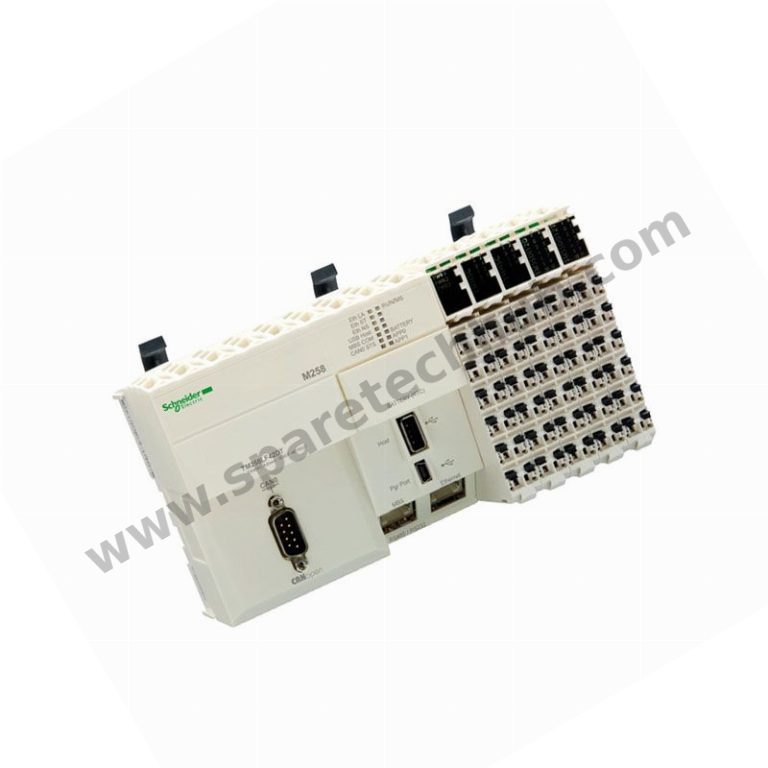
| Compact machine control | Schneider Electric TM258LF42DT | M258 compact base, 42 I/O, 24 V DC, CANopen |
| Micro PLC | GE IC200UDR005 | VersaMax Micro 28-point PLC, 16 inputs, 11 relay outputs, one transistor output |
| Ethernet to the M580 rack | Schneider Electric BMENOC0311 | FactoryCast Ethernet module for Modbus TCP and EtherNet/IP |
| Temperature and analog input | Schneider Electric TM3TI4 | 4 analog or temperature inputs, PT100 and Type K ranges |
| High-density analog input | Schneider Electric 140ACI05100SC | 32-point Quantum input module, 12 or 16 bit, 500 V DC isolation |
| Operator display | GE IC754VSI12CTD-HH | QuickPanel View HMI with a 12-inch color touchscreen |
| Machine operator panel | FANUC A02B-0200-C081 | Operator interface panel for FANUC-controlled machines, quoted on request |
| Servo motion | Siemens 1FK7022-5AK71-1LH0 | SIMOTICS S-1FK7 compact servo, 0.85 Nm, 0.38 kW at 6000 rpm, 20-bit encoder |
| Hygienic motion | B&R 8JSB31.ee050ff00-0 | Stainless steel servo motor designed to EHEDG hygiene standards |
More options are grouped by function in our PLCs and controllers, communication and I/O, power supplies, HMIs and touch panels, industrial sensors and servo motors and drives categories. Brand-level listings are available for Schneider Electric, Siemens, ABB and GE.
What should maintenance and integration teams do now?
The deal is expected to close around January 2027, which gives plant teams a short but useful window. Use it to remove uncertainty rather than to speculate about the roadmap.
- Inventory the installed base. List every OnLogic unit by configuration ID, not by family name, and note the line and application it serves.
- Capture the software state. Export BIOS settings, license keys, network configuration and a tested disk image for each distinct configuration.
- Get support commitments in writing. Ask the current account team how warranty, repair and technical support will be administered after the close.
- Ask about end-of-life policy. A longer production-life commitment is worth more than a discount, especially on validated lines.
- Qualify a second source for adjacent hardware. Switches, power supplies, I/O modules and HMIs do not need to come from the same vendor as the IPC.
- Review the network design. An edge computer is only as reliable as the switch port and the segmentation behind it.
- Revisit the plan after the close. Set a review date for the first quarter after the transaction completes, when the support model is clearer.
If the edge layer is part of a larger refresh, our guide to Schneider Modicon 140 modules covers the legacy Quantum I/O and processor combinations that often sit underneath these architectures. For the wider supply picture, see our 2026 review of industrial automation lead times and our earlier analysis of Siemens industrial AI investment.
Bottom line
Omron is not buying a computer company because it wants to sell computers. It is buying the layer where sensor data becomes a decision, and it is buying it at a multiple that assumes the layer will grow. The strategic logic is sound: sensing, control, motion, robotics and safety are all stronger when the machine can reason locally about what it is seeing.
For existing OnLogic customers, the hardware will not change on day one. The paperwork, the firmware cadence and the spare-part assumptions might. The teams that document their configurations now will have the least difficulty later, regardless of how the integration unfolds.
For everyone else, the deal is a useful marker. The industrial cabinet is no longer just relays, drives and a PLC. It is a small computing site, and the vendors are now organizing around that fact.
Need help specifying the cabinet around an edge computer? Send us the part numbers you are trying to match, and we will confirm condition, lead time and price. Start with the contact form or browse the networking and controller categories.
Frequently asked questions
When did Omron announce the OnLogic acquisition?
Omron announced the deal on October 13, 2026. The definitive agreement was signed on October 10, 2026. Omron expects to close around January 2027, subject to regulatory approvals and customary closing conditions.
How much is Omron paying for OnLogic?
The enterprise value is 675 million US dollars, on a cash-free and debt-free basis. Omron will pay all cash from its own funds. At 155 yen per dollar, the company values the deal at about 104.6 billion yen. That equals 4.4 times OnLogic FY2025 revenue of 154.2 million dollars and 24.9 times adjusted EBITDA of 27.1 million dollars.
Will OnLogic keep its brand and direct sales model?
Yes. Omron says OnLogic will operate as a standalone business inside the group. The OnLogic brand, direct sales model, global offices and management team, including CEO Sean Larkin, are expected to remain in place. No plant closures or product discontinuations were announced with the deal.
What products does OnLogic make?
OnLogic builds rugged industrial computers and edge servers. The portfolio includes the Karbon 520 and Karbon 800 fanless systems, the Helix family and panel PCs up to 24 inches. Many models are configured to order, with wide operating temperature, shock and vibration testing, and options for NVIDIA graphics or Intel NPU acceleration.
Does the acquisition change support or spare parts for existing OnLogic units?
No change has been announced. Units already shipped keep their existing warranty and support terms. The main risk is administrative rather than technical: support portals, firmware cadence and end-of-life notices may move under Omron processes after the close. Record the exact configuration and firmware of each unit now.
Why does an automation company need an industrial PC maker?
AI models for inspection, predictive maintenance and robot guidance need compute close to the machine. Sending every camera frame to a distant cloud adds latency, cost and a network dependency. Omron has sensors, controllers, motion and robots, but it did not own a broad rugged computing platform. OnLogic supplies that layer.
Sources
- Omron Corporation, corporate news release dated October 13, 2026 (primary announcement). omron.com/global/en/news
- SEMI China, “Omron to acquire OnLogic for $675 million,” October 14, 2026. semi.org.cn
- 仪表网, “Omron acquires US industrial PC maker OnLogic for $675 million,” October 20, 2026. ybzhan.cn
- OnLogic, Karbon 522 product page. onlogic.com/store/k522
- OnLogic, company news and product information. onlogic.com/company/news