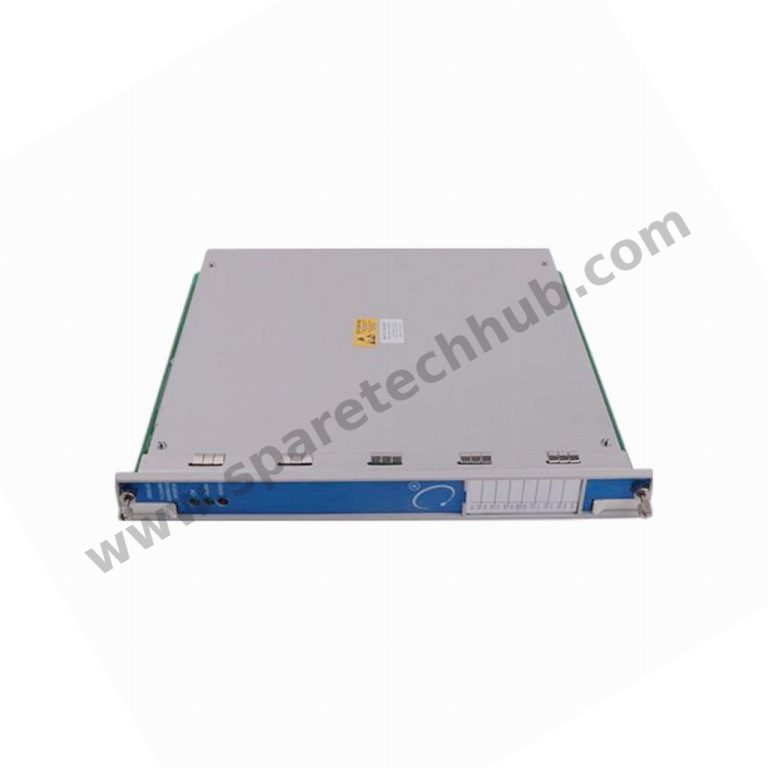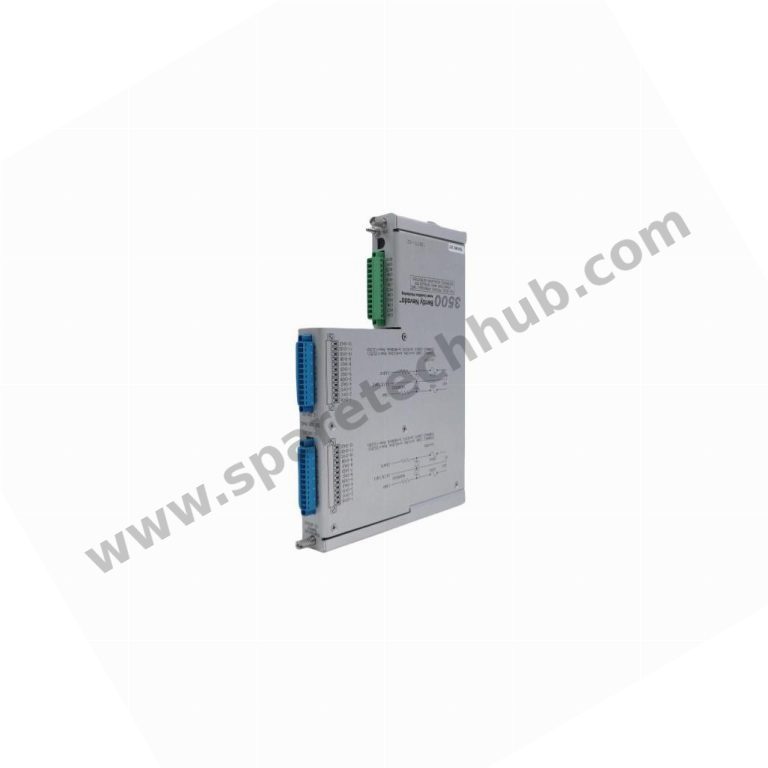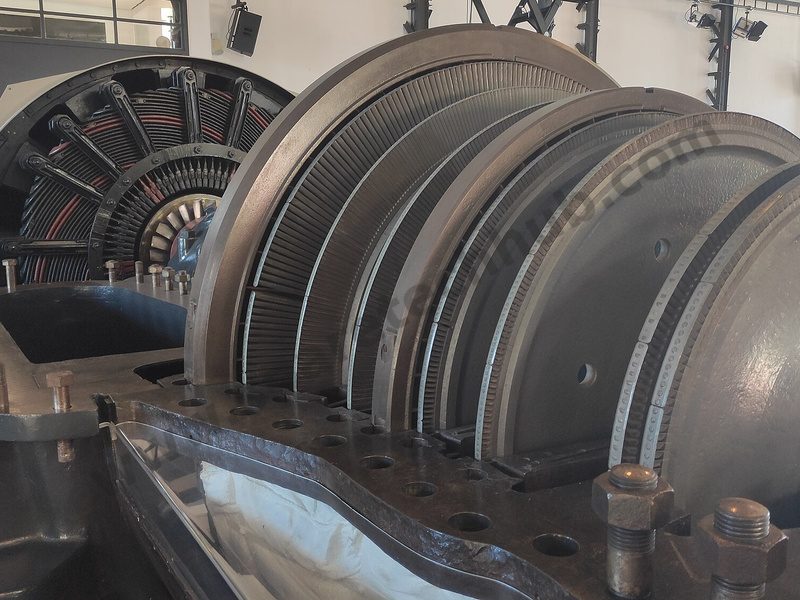
The Bently Nevada Orbit 60 Condition Monitoring Module (CMM) is not an input card. It is the module that reads what the rack already knows — measurements, waveforms, digital transducer signals, system controls, status, configuration, process data from external systems, and the alarm and event logs — and makes it available to System 1 over the business network. Bently Nevada states the read direction plainly: the CMM “only listens, with no capability to write.”
Two codes are orderable today. 60R/CMM01-AAA-B occupies two slots; 60R/CMM02-AAA-B occupies one. The number often quoted alongside this module, 145M9028, is the datasheet document number (currently Rev. D, 2025), not a part number. A third variant, CMM Lite, has been announced without a solid-state drive, but Baker Hughes has not published an order code for it and places it with the 7- and 11-slot Orbit 60 Compact racks due in early 2027.
TL;DR
- Read-only toward the backplane, bi-directional toward System 1. The one-way boundary is inside the rack. System 1 still writes configuration to the CMM to select extra measurements and waveforms.
- Two order codes, one SIL option. 60R/CMM01 (two slots) and 60R/CMM02 (one slot); B is fixed at 0, meaning No SIL, for both.
- The offline buffer exists; its size does not. Non-volatile storage holds historical data until System 1 off-loads it. Capacity, retention time and backfill rate are not published.
- Not in the protection path. The datasheet calls the module non-interfering with the safety system; SIL 2 does not require it to be SIL certified.
- No channel count, no sample rate. The CMM is not an input module. Channels and sampling belong to the dynamic input modules and the PPM.
- Replacement trap. Swapping a CMM01 for a CMM02 needs a 60R/BLK01 blank module and System 1 version 25.2 or later.
What does 145M9028 refer to, and which CMM part numbers can you actually order?
145M9028 is the document number of the Orbit 60 Condition Monitoring Module datasheet, currently Rev. D, not an order code. Only two CMM codes are orderable: 60R/CMM01-AAA-B, which occupies two slots, and 60R/CMM02-AAA-B, which occupies one. AAA selects hazardous-area certification; B is fixed at 0, meaning no SIL level.
The datasheet’s ordering table lists the two codes separately rather than as one code with a slot option, which is why a two-slot and a one-slot module can be mistaken for revisions of the same item. They are not. The physical table gives required rack space as 2 slots for 60R/CMM01 and 1 slot for 60R/CMM02, and the replacement note treats them as distinct modules.
| Order code | Rack slots | AAA — hazardous-area certification | B — SIL level | Status |
|---|---|---|---|---|
| 60R/CMM01-AAA-B | 2 | 00 no hazardous area; 01 CSA/NRTL/C Class I Div 2; 02 Multi (CSA, ATEX, IECEx) | 0 No SIL | Orderable |
| 60R/CMM02-AAA-B | 1 | Same three options; country-specific approvals quoted separately | 0 No SIL | Orderable |
| CMM Lite | 1 | Not published | Not published | Announced, early 2027 |
Certification is not a free choice. The code has to match the area classification of the rack, and the same module carries cNRTLus Class I Division 2 Groups A, B, C, D T4 and ATEX/IECEx II 3 G Ex ec nC IIC T4 Gc listings. Buyers replacing a module in a classified area should quote the existing code rather than the cheapest available variant.
Does the CMM really only listen, and where does the one-way boundary sit?
The one-way boundary sits between the CMM and the protection backplane, not between the CMM and the network. Inside the rack it only receives: Bently Nevada states the module has no capability to write and prevents changes on the protection backplane. Toward System 1 the link is bi-directional, because System 1 configures which extra measurements and waveforms the CMM collects.
Baker Hughes describes the mechanism at the circuit level. The module contains data isolation circuitry that separates the condition monitoring network from the protection network, and the company’s product manager calls the circuit a “listen-only mode” to the process network, adding that there are “no bi-directional electronics” in that direction. All data is broadcast to the CMM automatically; the CMM does not request information from the protection system.
Two things follow for anyone writing a network design document. First, the Ethernet side is not one-way. Each of the two RJ-45 ports is independently configurable and autonegotiates at 10, 100 or 1000 Base-T, and System 1 writes configuration to the module. Second, the isolation is described as circuitry and data isolation, not as a fibre one-way gateway; the datasheet does not claim a physical single-strand link. The security claim in the documentation is that the module is designed to meet IEC 62443-4-2, with the segregation of protection and condition monitoring functions.
Without System 1 connected, the same module still has a use: Bently Nevada notes that data can be collected to diagnose machinery issues when an alarm event occurs in the hardware. That is a diagnostic path, not a substitute for the protection logic in the 3500/53 overspeed module or its Orbit 60 equivalents.
What happens to condition data when System 1 or the network goes offline?
Condition data streams to System 1 continuously. When the connection drops, the CMM writes historical data to non-volatile storage and holds it until the host software off-loads it. Bently Nevada does not publish buffer capacity, retention time or a backfill rate, so any specific number of buffered days for the standard module is an estimate, not datasheet data.
The datasheet sentence is short: data is transferred continuously, and if the connection is lost, non-volatile storage buffers historical data until the information is off-loaded to the host software. It does not name the medium, the size or a replay limit. The SSD detail comes from a separate Baker Hughes announcement, which describes the standard CMM as carrying a solid-state drive and the Lite variant as shipping without one.
For the Lite variant the same announcement gives a relative figure: its buffer is about 5% as large as the SSD version, which it frames as less fault tolerance for network outages exceeding a day or two. That sentence is the only official statement that connects buffer size to outage length, and it is relative, not absolute.
Two design consequences are worth recording. Buffer sizing should be quoted by Baker Hughes against your own channel count, waveform demand and storage rate, not assumed from a rule of thumb. And an outage in the condition monitoring path must not be written into a protection narrative: the CMM is outside the protection path, so protection continues while System 1 is disconnected.
Which variant fits which rack — CMM01, CMM02 or CMM Lite?
Slot count, storage and availability separate the three variants. 60R/CMM01 takes two slots and 60R/CMM02 takes one, both orderable now with B fixed at 0. CMM Lite, announced without an SSD and with about five percent of the SSD version’s buffer, has no published order code and arrives with the 7- and 11-slot Compact racks in early 2027.
| Attribute | 60R/CMM01 | 60R/CMM02 | CMM Lite |
|---|---|---|---|
| Order code | 60R/CMM01-AAA-B | 60R/CMM02-AAA-B | None published |
| Rack slots | 2 | 1 | 1 (announced) |
| Solid-state drive | Yes, per Baker Hughes announcement | Yes, per Baker Hughes announcement | No |
| Offline buffer | Baseline | Baseline | About 5% of the SSD version |
| Chassis | 3U 19-slot and 6U 28-slot | Same, and practical for 7- and 11-slot Compact racks | 7- and 11-slot Compact racks |
| Availability | Current | Current | Early 2027 |
| SIL option | B = 0 only | B = 0 only | Not published |
Slot arithmetic is the practical constraint. A 3U chassis offers 19 general-purpose slots and a 6U chassis offers 28, but power, SIM, PPM, CGW and input modules all draw from the same pool. Moving from a two-slot CMM to a one-slot CMM frees a slot; it does not add a monitoring channel, because the CMM never owned a channel. Baker Hughes also notes that multiple CMM modules allow two independent System 1 clients, so a site that wants two clients must budget two modules, not one module and two licences.
How do the CMM, PPM and CGW divide the work?
The PPM computes protection measurements and alarm decisions, the CGW exchanges process data and controls with the control system, and the CMM carries data to System 1 for diagnostics. Only the CMM is the System 1 path. It does not vote, trip or translate Modbus or EGD for the plant control system.
The Protection Processing Module is the computational engine for protection: it extracts machinery measurements, performs alarm determinations and publishes results for collection. The Communication Gateway carries measurements, alarms, statuses and controls to external hosts over Modbus TCP/IP or EGD and receives inhibit, reset and trip-multiply commands from the control system. The System Interface Module holds configuration and the protection fault relay. The CMM sits beside these as the S1 Interface, reading the system data bus and forwarding it to condition monitoring software.
That division is why a CMM cannot be described as a protection upgrade. It changes what the maintenance team can see, not what the rack will do when a setpoint is crossed.
What does the CMM datasheet actually specify?
The published specification covers power, network, environment and certification, but not storage. The CMM draws 10.5 W typical and 14.2 W maximum, presents two independent RJ-45 ports at 10/100/1000 Base-T with a 100 m cable limit, and is rated for 3U chassis operation from −30 °C to +70 °C. Buffer size is not stated.
| Parameter | Published value |
|---|---|
| Ethernet ports | 2 independent RJ-45 ports, utility or rear side |
| Link speed | 1000/100/10 Base-T autonegotiation |
| Cable length | 100 m (328 ft) maximum |
| LEDs | Module OK and LINK |
| Power consumption | Typical 10.5 W; maximum 14.2 W |
| Module temperature rating | −30 °C to +70 °C (−22 °F to +158 °F) |
| 3U chassis operating range | −30 °C to +70 °C; above 50 °C requires forced air at 0.5 m/s minimum |
| 6U chassis operating range | −30 °C to +65 °C |
| Storage temperature | −40 °C to +85 °C |
| Relative humidity | 0% to 95% non-condensing, operating and storage |
| Vibration | 0 to 0.35 g at 57–500 Hz without isolators; 0 to 5 g with isolators |
| Shock and altitude | 2 in incline drop; below 2,000 m (6,562 ft) |
| EMC and safety | EN 61000-6-2, EN 61000-6-4, EN 61010-1, EN 61010-2-201 |
| Cyber security | Designed to meet IEC 62443-4-2 |
| Hazardous area | Class I Div 2 Groups A–D T4; ATEX/IECEx II 3 G, T4 at −30 °C to +70 °C |
| Marine | ABS rules for condition of classification |
Notice what is absent: channel count, sample rate, storage capacity and buffer duration. Those numbers do not exist for this module because it does not digitise sensor signals. A specification table that lists a channel count for a CMM is describing the rack, not the module.
Does the CMM take part in protection or trip logic?
No. The datasheet states the CMM is non-interfering with the safety system and that the system’s SIL 2 certification does not require this component to be SIL certified. The ordering code fixes B at 0, No SIL. Protection measurements and voting stay in the PPM, SIM and relay modules, independent of whether System 1 is connected.
This is a deliberate design choice, not an omission. A module that cannot write to the protection backplane also has no path to influence a trip decision, which is what allows the business network connection to exist at all. Treat the “no risk to the protection system” wording as the vendor’s design claim supported by the isolation circuitry, and keep the protection loop documentation separate from the condition monitoring network documentation.
What changes when a two-slot CMM01 is replaced by a one-slot CMM02?
Two line items change. A blank module, 60R/BLK01, must be ordered to fill the empty slot left by the two-slot module, and System 1 must be version 25.2 or later for complete support. Plan both before the swap, because the blank module does not ship with the CMM.
The datasheet states the requirement directly: replacing an existing 60R/CMM01 two-slot CMM with a 60R/CMM02 single-slot CMM requires an additional blank module, part number 60R/BLK01, to fill the unused slot, and System 1 must be version 25.2 or higher to support the new module completely. A maintenance team that orders only the CMM will hold a rack with an open slot and a software version it has not checked.
How does the Orbit 60 CMM compare with the 3500 rack’s System 1 path?
They are different platforms, not interchangeable cards. The 3500/22M TDI links a 3500 rack to System 1 at 100 Mbit/s over 100Base-FX fiber or copper, while the Orbit 60 CMM offers two gigabit-capable RJ-45 ports and a one-way listen path into the protection backplane. A CMM cannot be fitted to a 3500 rack.
| Attribute | 3500/22M TDI | Orbit 60 CMM |
|---|---|---|
| Platform | 3500 rack | Orbit 60 chassis |
| System 1 link | 100 Mbit/s; 100Base-FX multimode fiber or 10/100Base-TX copper | 2 × RJ-45, 10/100/1000 Base-T autonegotiation |
| Cable limit | 2,000 m fiber; 100 m copper | 100 m |
| Direction to protection system | Not part of the critical monitoring path | Listen-only into the backplane |
| Offline buffering | Buffers transient data | Non-volatile storage, capacity not published |
| Slots | 3500 module slot | 1 or 2 general-purpose slots |
For an installed 3500 fleet the TDI remains the System 1 path, and the 3500/22M TDI overview covers its 100 Mbit/s limit and buffering behaviour. For a new build, the Orbit 60 route is a different chassis, backplane and configuration tool. The two platforms do meet at the cabinet: Baker Hughes states that a two-3U Orbit 60 form factor was designed to fit the space of a single 19-inch rackmount 3500 unit as a retrofit, so a migration is a rack-level project rather than a card swap.
Which spare-parts decisions should be settled before ordering?
Settle four things before ordering: the slot width you can spare, the certification code that matches the area classification, whether a second System 1 client needs a second CMM, and whether the site can wait for CMM Lite. Get the blank module and System 1 version confirmed in the same requisition.
- Width, not just model. A 60R/CMM01 spare will not fit a slot budget planned around 60R/CMM02, and the reverse leaves a gap. Stock the width that is actually installed, and record it in the asset register next to the rack serial.
- Certification code. The AAA block must match the area classification. Mixing a 00 module into a Class I Div 2 rack is a compliance problem, not a compatibility problem.
- Second client. Two independent System 1 clients require two CMM modules, each with its own slot allocation.
- Roadmap risk. CMM Lite has no order code and a 2027 timeframe. Do not write it into a 2026 bill of materials as an available option.
- Buffer expectation. Because capacity is unpublished, agree the outage tolerance with the vendor in writing rather than inferring it from the Lite ratio.
Our Bently Nevada spare parts guide maps the common rack modules and sensor families for mixed 3500 and Orbit 60 sites, and the condition monitoring payback case covers the data side of the same decision. If you are sizing spares for a specific rack, send us the slot count and the installed module list and we will check it against the ordering table.
What is not published?
Five items are missing from the public documentation: buffer capacity, retention time, backfill rate, the CMM Lite order code, and an SSD size. The datasheet does name non-volatile storage and a continuous stream to System 1, but any capacity or day-count figure quoted without a Baker Hughes source should be treated as unverified.
One documentation inconsistency is also worth flagging. Rev. D of the datasheet says in its description that “each module occupies one slot within the system”, while the physical table and the ordering table both distinguish a two-slot 60R/CMM01 from a one-slot 60R/CMM02. For slot planning, use the physical table and the order code, not the descriptive sentence.
The same rule applies to related Orbit 60 parts. The 350900 high-temperature sensor carries a temperature split that is routinely misquoted, and module datasheets in this family are revised without a change note on the public page. Always quote the revision you are working from.
Sources
- Baker Hughes, ORBIT 60 SERIES Condition Monitoring Module Datasheet, 145M9028 Rev. D (2025).
- Baker Hughes, ORBIT 60 SERIES System Overview Datasheet, 137M5182 Rev. N.
- Baker Hughes, “Orbit 60: a data secure condition monitoring system” (CMM data isolation circuitry, listen-only mode, no bi-directional electronics).
- Baker Hughes, “Introducing the Power of Orbit 60 in a Compact Form Factor” (single-slot CMM, CMM Lite without SSD, buffer about 5% of the SSD version, 7- and 11-slot racks, early 2027).
- Baker Hughes, Orbit 60 product page and Condition Monitoring Module datasheet download (145M9028).
Verified 17 November 2026 against the documents above. Figures are quoted as published by Baker Hughes; no capacity, channel or sampling values have been estimated.
Frequently asked questions
Can a one-slot 60R/CMM02 replace a two-slot 60R/CMM01 in an existing chassis?
Yes, provided System 1 is version 25.2 or later and a 60R/BLK01 blank module is ordered to fill the slot the two-slot module leaves empty. The CMM02 uses one general-purpose slot instead of two, so the change frees capacity for another module or a blank panel. Without the blank module the chassis keeps an open slot that Bently Nevada’s replacement note specifically requires you to close.
Does the CMM need SIL certification when the rack is used in a SIL 2 loop?
No. The datasheet states that the module is non-interfering with the safety system and that the system’s SIL 2 certification does not require this component to be SIL certified. The order code confirms it: B is fixed at 0, No SIL, for both 60R/CMM01 and 60R/CMM02. Protection functions remain in the PPM, SIM and relay modules.
How much data does the CMM keep while System 1 is unreachable?
The datasheet confirms that non-volatile storage buffers historical data until the host software off-loads it, but it does not publish capacity, retention time or a replay rate. The only official sizing statement is relative: CMM Lite buffers about 5% of what the SSD version holds, which Baker Hughes associates with less fault tolerance beyond a day or two. For the standard module, ask Baker Hughes to size the buffer against your channel count and storage rate.
Do two CMM modules really give two independent System 1 clients?
Yes. Bently Nevada states that placing multiple CMM modules allows the connection of two independent System 1 clients to the same Orbit 60 system. Each module needs its own slot allocation, and two modules in one chassis consume two or four general-purpose slots depending on whether they are CMM02 or CMM01 units.
Can I order CMM Lite today?
Not against a published order code. CMM Lite has been announced as the variant without a solid-state drive, for the 7- and 11-slot Orbit 60 Compact racks listed for early 2027, and its buffer is described as about 5% of the SSD version. Until an order code appears, treat it as a roadmap item rather than a spare-part option.