Littelfuse published the C&K SDE Series on 20 October 2026 as a low-profile, end-stackable surface-mount DIP switch for high-density board layouts. The verifiable core is short: SPST, 1 to 10 and 12 positions, 24 V DC at 25 mA switching and 100 mA non-switching, 1,000 mechanical and electrical cycles, 2.54 mm pitch, and 3.7 mm height above board across the 22 SKUs Littelfuse currently lists. What the launch coverage added around that core – self-cleaning contacts, shock resistance, an ultra-low operating height, dust and corrosion protection for DIN-rail PLC I/O modules – is either published for a different C&K family or not published for SDE at all.
That distinction is not pedantry. A configuration switch inside an I/O expansion module is a service item. Someone will read it, change it, or argue about it three years after the board left the factory, and the datasheet is the only document that will be in the room. Below is what the primary Littelfuse documents actually say, what they leave open, and how to design and stock around it.
In short: what is confirmed and what is not
- End-stacking is the real feature. The SDE body butts against its neighbour on a standard 0.1 inch (2.54 mm) integrated circuit pitch, so two banks of different position counts read as one continuous row instead of two separate board areas.
- The rating is signal-level, not load-level. 24 V DC at 25 mA switching, 100 mA non-switching, maximum contact resistance 100 milliohm. This is an addressing and configuration switch, not a power switch.
- Life is 1,000 cycles for both mechanical and electrical – published as a single combined figure.
- Height above board is 3.7 mm in Littelfuse part data for every published SDE SKU, including the extended-actuator variants.
- Self-cleaning or bifurcated contacts are not claimed for SDE. Bifurcation is published for the C&K TDA and TDB half-pitch families; contact wiping is published for the through-hole Series 206 and 208.
- No shock or vibration specification appears in the SDE datasheet. The environmental rows are storage temperature and moisture sensitivity only.
- Washability is internally inconsistent. The datasheet says the polyimide top tape seal supports washable processing; Littelfuse part data marks washing process compatibility as not compatible for all 22 SKUs, and every extended-actuator SKU is ordered without the tape seal.
- Every switch ships in the OFF position, stated twice in the datasheet. Any board that depends on a default-ON bit needs that in the assembly instruction, not in the datasheet.
What Littelfuse actually announced
The release is titled Littelfuse/C&K Introduces SDE Series Low-Profile, End-Stackable Surface-Mount DIP Switches and is dated 20 October 2026 in Littelfuse’s news index. Its subhead reads: new gold-plated, washable DIP switches enable high-density PCB layouts in space-constrained designs. C&K Switches has been part of Littelfuse since the 2022 acquisition, and the datasheet carries the C&K Switch Datasheet masthead with a Littelfuse copyright and a revision line of 07/21/26.
The datasheet describes the product in one sentence worth quoting because it is the design intent in the manufacturer’s own words: a modular side-by-side stacking concept allows easy configuration expansion while ensuring reliable, precise switching performance. The four feature bullets are end-stacking at 0.1 inch IC pitch, a molded 0.3 inch IC packing outline that allows automatic insertion, a top tape seal to support washable processing, UL 94V-0 rated plastics throughout, and RoHS compliance with halogen-free material.
The application list is where the launch coverage and the datasheet diverge most. Littelfuse names industrial control equipment, security and fire systems, garage door systems and IoT devices; the product page adds communications equipment and compact electronic systems. Neither document names PLC I/O expansion modules or fieldbus node addressing. Those are a reasonable reading of industrial control equipment, and they are the use case this article is written for – but they are an interpretation, not a manufacturer claim, and if a buyer needs a documented endorsement for a specification sheet, the datasheet does not provide one.
Verified specification snapshot
Every value below is taken from the SDE datasheet or from Littelfuse’s published part data for the series. Nothing here is inferred.
| Specification | Published value | Where it comes from |
|---|---|---|
| Circuit | SPST, 1 to 10 and 12 positions, each position an independent circuit | Datasheet, Switch Function |
| Contact rating, switching | 24 V DC, 25 mA | Datasheet, Contact Rating |
| Contact rating, non-switching | 100 mA | Datasheet, Contact Rating |
| Contact resistance | 100 milliohm maximum | Datasheet |
| Insulation resistance | 100 megohm minimum at 100 V DC | Datasheet |
| Dielectric strength | 500 V DC minimum for 60 seconds | Datasheet |
| Mechanical and electrical life | 1,000 cycles | Datasheet; repeated as 1000 in part data |
| Operating force | 800 g maximum | Datasheet; part data lists 800 |
| Storage temperature | minus 40 C to plus 85 C | Datasheet, Environmental |
| Moisture sensitivity | MSL 1 | Datasheet; soldering reference IPC/JEDEC J-STD-020D |
| Pitch | 2.54 mm (0.1 inch) | Datasheet feature list; part data Pitch 2.54 |
| Height above board | 3.7 mm | Littelfuse part data, all 22 SKUs |
| Termination | Gull wing, surface mount, insert-molded copper-alloy terminals, gold flash over nickel | Datasheet, Materials |
| Contacts | Copper alloy, gold plate over nickel plate | Datasheet, Materials |
| Case, cover, actuator, seal | PPS case and cover, LCP actuator (both UL 94V-0), polyimide tape seal | Datasheet, Materials |
| Packaging | Tube or tape and reel | Datasheet; see order code below |
| Default state at shipment | All positions OFF | Datasheet, stated twice |
Four launch claims that need checking
| Claim in circulation | What the primary documents publish | How to treat it |
|---|---|---|
| Self-cleaning, shock-resistant contact surface | The SDE datasheet describes gold plating over nickel on a copper-alloy contact. No bifurcation, no wiping action and no shock test appear anywhere in it. Bifurcated contacts are published for C&K TDA and TDB; contact wiping on make and break is published for the through-hole Series 206 and 208. | Do not carry the claim into a specification. If a wiping or bifurcated contact is a requirement, the requirement points at a different family. |
| Shock and vibration resistance | The environmental section publishes storage temperature and MSL 1 only. | Treat as unpublished. For a vibration-exposed mounting, qualify it in your own test or select a family with a published shock condition. |
| Ultra-low operating height | The series name says Low Profile. Littelfuse part data gives height above board 3.7 mm for all 22 SKUs. The datasheet drawing labels dimension A as bank length per position count, not height. | Use 3.7 mm as the clearance number and re-check it against the drawing package, since the label mapping is not recoverable from the published text. |
| Dust and corrosion protection | What is published is a polyimide top tape seal, gold contact plating, UL 94V-0 housing and halogen-free material. No ingress protection rating is published. | The tape seal is a process seal for reflow and cleaning, not a field seal. A top-actuated switch on a module front face stays exposed to the enclosure environment. |
| Washable processing | Datasheet: top tape sealed to support washable processing. Part data: washing process compatibility not compatible for all 22 SKUs. Every extended-actuator SKU carries the no-tape option. | Resolve with Littelfuse or the distributor in writing, then run a wash trial on your own board before committing a production process. |
The pattern is worth naming for anyone who reuses launch summaries as engineering input. The SDE release is the third compact SMT DIP family Littelfuse has put out in 2026, after TDA-adjacent positioning and the TDB half-pitch release of 7 April 2026. Marketing language travels between releases, and the specific technical claims attached to one family – bifurcated contacts, washability – get inherited by the next one in the summary even when the newer datasheet does not repeat them.
The order code, decoded
The datasheet presents a build-a-switch string: SDE, two digits for position count, then four option fields. Read left to right, every field is a real fork in the part you receive.
| Field | Option | Meaning |
|---|---|---|
| Positions | 01 to 10, 12 | Number of independent SPST circuits; sets bank length |
| Actuator | H0 | Flush actuator |
| Actuator | H1 | Extended actuator |
| Termination | S | Gull wing, surface mount |
| Contact material | B | Gold |
| Sealing | no letter | Top tape seal fitted |
| Sealing | D | Without tape |
| Packaging | no letter | Tubes |
| Packaging | R | Tape and reel |
So SDE08H0SBR is an 8-position, flush, gull-wing, gold-contact switch with the tape seal, on reel. SDE08H1SBD is the same 8 positions with an extended actuator, no tape seal, in tubes. Two fields that look cosmetic – sealing and packaging – change what the part number can be used for: the reel code is what an SMT line needs, and the tape option is the only thing in the code that touches the wash question.
Which 22 SKUs Littelfuse actually publishes
The build-a-switch matrix implies 22 combinations of actuator, seal and packaging across 11 position counts, and Littelfuse’s internal codes G01939283 through G01939304 cover exactly 22 parts. The distribution is not symmetric, and the asymmetry is the kind that surprises a buyer at the second source check.
| Positions | Bank length A, mm (tolerance plus or minus 0.5) | Pitch span 2.54 x (P minus 1), mm | Flush, taped, reel (H0SBR) | Extended, no tape, reel (H1SBDR) | Extended, no tape, tube (H1SBD) |
|---|---|---|---|---|---|
| 1 | 2.5 | 0 | Yes | Yes | No |
| 2 | 5.04 | 2.54 | Yes | No | No |
| 3 | 7.58 | 5.08 | Yes | No | No |
| 4 | 10.12 | 7.62 | Yes | No | No |
| 5 | 12.66 | 10.16 | Yes | No | No |
| 6 | 15.2 | 12.7 | Yes | No | No |
| 7 | 17.74 | 15.24 | Yes | Yes | Yes |
| 8 | 20.28 | 17.78 | Yes | Yes | Yes |
| 9 | 22.82 | 20.32 | Yes | Yes | Yes |
| 10 | 25.36 | 22.86 | Yes | Yes | Yes |
| 12 | 30.43 | 27.94 | Yes | Yes | Yes |
Three consequences follow directly from that table. First, positions 2 through 6 exist only as flush, taped, reel-packaged parts: if a design needs a taped 4-position switch in tubes, it is not a published SKU. Second, no extended-actuator part is published with the tape seal, so the washable-seal and finger-operable requirements cannot both be met from the current list. Third, the 12-position part is a genuine 12, not a 10 plus 2 – its bank is 30.43 mm long, which is a real constraint on where it can sit next to a connector.
What end-stacking buys you on the board
End-stacking means the switch body is shaped so that two switches placed along the same 2.54 mm grid abut without a gap that has to be designed around. The practical value is in the layout, not in the datasheet: a 4-position bank and an 8-position bank placed end to end read as one 12-position row to the person holding the stylus, while the silkscreen, the assembly drawing and the service documentation can label them separately.
The second feature bullet is the molded 0.3 inch integrated circuit packing outline allowing automatic insertion. The 0.3 inch (7.62 mm) row spacing is the standard dual in-line package spacing, so the SDE body presents to a board like an IC footprint rather than as a bespoke component needing its own feeder or hand placement. Combined with tape and reel packaging on every flush SKU, that is the manufacturability argument for the series: it behaves like an IC on an SMT line.
What the concept does not do is create a shared circuit or a mechanical lock. Each switch remains an independent set of SPST positions, and butt-to-butt placement still depends on your placement accuracy and on the neighbouring components not intruding on the actuator access. Leave the tooling clearance the datasheet implies rather than the theoretical body width: an 800 g maximum operating force means a stylus or a fingernail, not a screwdriver, and the flush actuator needs something to press into.
Configuration switches inside PLC I/O expansion modules
For the buyer who never lays a board, the SDE series matters because it is the component class inside the modules on the DIN rail. The dense, low-profile, top-actuated form factor is exactly what a modern expansion module uses when it still exposes a hardware setting at all.
Two examples from our own catalogue make the point concrete. The SEW Eurodrive MOVIMOT MM 05D-503-00 integrated drive documents a factory PWM frequency of 4 kHz, selectable to 8 or 16 kHz via DIP switch S1/7, with automatic thermal derating at the higher setting – one switch position changing a parameter that then changes the cooling budget of the whole mounting. The smaller MM 03D-503-00 carries the same arrangement. That is what a DIP switch is on a product: a documented, deliberate override, with consequences written in the manual.
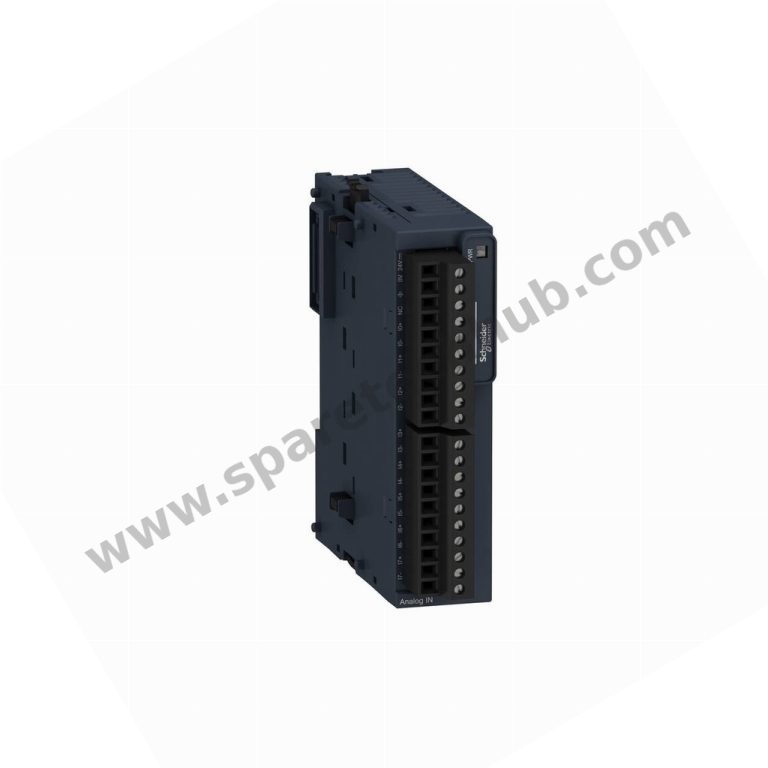
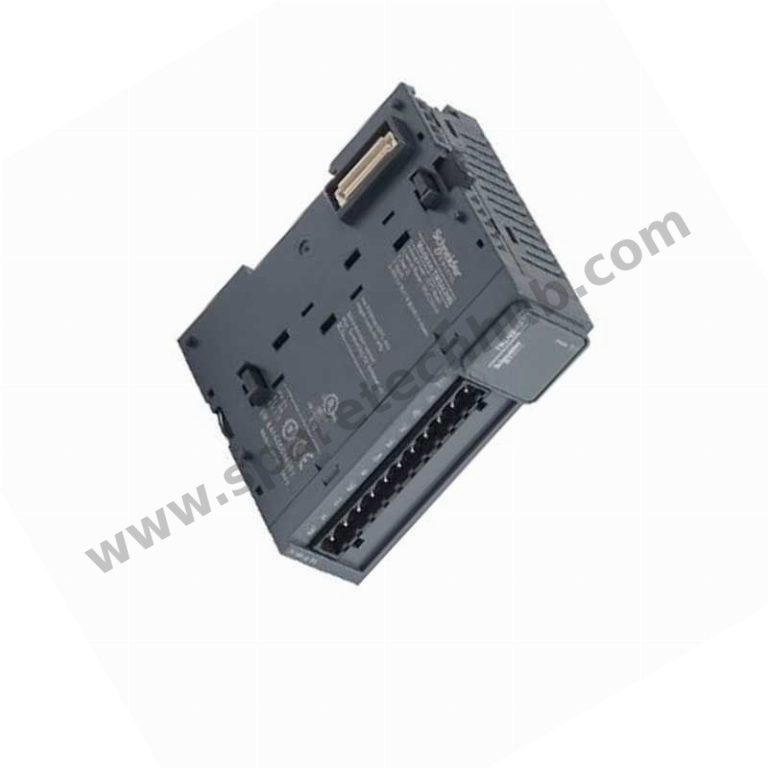
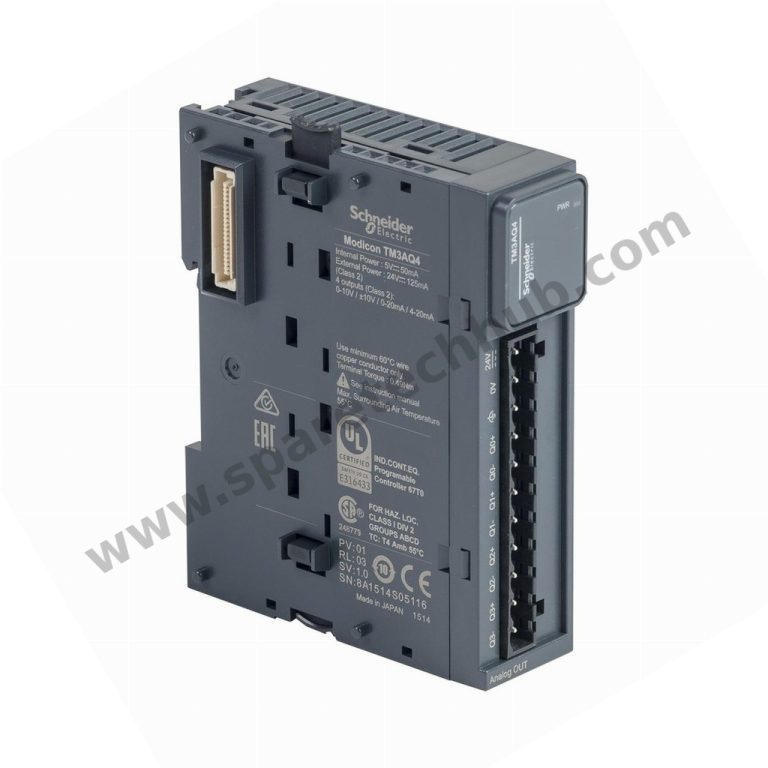
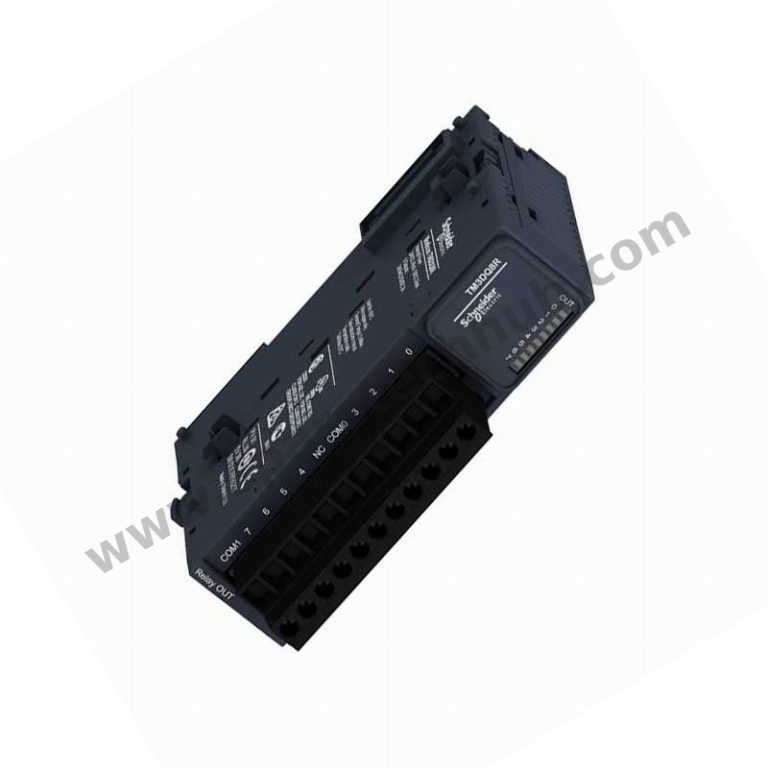
The same logic runs through the Schneider Electric hardware we hold. Expansion and coupling modules in the Modicon TM3 family – for instance the TM3AI8 analog input module, the TM3TI4 temperature input module, the TM3AQ4 analog output module or the TM3DQ8R discrete output module – are the class of board that carries configuration hardware behind a front label. In the Modicon TM5 range the same applies to the TM5NS31 Sercos III communication module, the TM5SDO12T and TM5SDI16D digital modules, and the TM5SPS3 power distribution module, which is where a bank of settings usually gets its supply stability tested.
Remote I/O is where the address-setting use case is strongest. Advantys STB stations in our Advantys STB category, such as the STBNDN1010 Ethernet adapter or the STBXBA3000 base plate, and Communication and I/O hardware such as the Momentum base module 110XTS00122, are the parts most likely to have a hardware node identifier that has to survive a replacement. The Zelio Logic controllers SR3B261BD and SR2B121BD are the smaller-machine equivalent.
The service consequence is the one that gets missed. When a module with a hardware setting fails, the replacement arrives with its switch bank in whatever the factory default is – for an SDE-based board, that is every position OFF, because Littelfuse supplies all switches in the OFF state. Unless the as-installed pattern was recorded, the machine comes back wrong. Photograph the switch bank at commissioning and put the pattern in the asset register, in the same field where you record the firmware revision.
How many positions an address actually needs
Position count is a binary question, and the datasheet gives you 11 choices. Here is what each buys in states, and the bank length you pay for it.
| Positions | States available | Typical use | Bank length, mm |
|---|---|---|---|
| 2 | 4 | Mode or option pair, range selection | 5.04 |
| 4 | 16 | One hex or BCD nibble, small address space | 10.12 |
| 6 | 64 | Device options plus a small identifier | 15.2 |
| 7 | 128 | Node identifiers covering 1 to 127 in straight binary | 17.74 |
| 8 | 256 | One byte, full 1 to 254 identifier space | 20.28 |
| 10 | 1024 | Parameter word or extended identifier | 25.36 |
| 12 | 4096 | Two hex digits, or identifier plus option bits | 30.43 |
Two cautions that apply to any board, whatever switch sits on it. Confirm whether the module reads the bank as straight binary, BCD or hex, and confirm which position is the most significant bit – module manuals disagree, and a reversed bank produces a valid-looking but wrong node address that is much harder to diagnose than an obvious fault. Then confirm whether the setting is read at power-up only, because most are: changing a switch with the module powered usually requires a cycle to take effect.
Assembly, washing and rework
On the assembly side the SDE series is unremarkable in the best way. Gull-wing terminals, MSL 1 so there is no floor-life clock to manage, a soldering reference to IPC/JEDEC J-STD-020D, and a tape-and-reel option on every flush SKU. The polyimide tape seal is there to keep solder and flux out of the contact chamber during reflow, which is the reason sealed SMT DIP switches exist at all.
The wash question is where the documents disagree, and it is worth resolving before a process audit rather than after. Littelfuse’s own part data marks washing process compatibility as not compatible for all 22 SKUs, while the datasheet bullet says the top tape seal supports washable processing, and the press-release subhead calls the switches washable. The extended-actuator parts, which are the ones a service technician can actually operate without a tool, are published only without the tape seal – so on the current list, finger operability and a sealed body are mutually exclusive.
For rework, the honest guidance is that a gull-wing SMD switch is a repairable part but not a fast one: hot-air removal of a low-profile body next to a row of abutting neighbours risks lifting pads and wicking solder into the adjacent switch. In a plant that measures downtime in line-hours, replacing the module and putting the defective one in the rework queue is usually the cheaper decision, which is why the spares argument below is about modules rather than switches.
How SDE compares with the rest of the C&K DIP range
| Family | Pitch | Mount | Contact | Published rating | Seal and wash | Positions |
|---|---|---|---|---|---|---|
| SDE | 2.54 mm full | SMT gull wing | Copper alloy, gold over nickel | 24 V DC, 25 mA switching / 100 mA non-switching | Top tape seal on flush SKUs; washing marked not compatible in part data | 1 to 10, 12 |
| TDA | 1.27 mm half | SMT | Bifurcated, gold | 100 mA, max 24 V | Process sealed for SMT soldering and washable processing | 1 upward |
| TDB | 1.27 mm half | SMT | Bifurcated, gold | 50 V DC, 100 mA steady state | Top-tape sealed for reflow and post-reflow aqueous cleaning | 2, 4, 6, 8, 10 |
| Series 206 and 208 | 2.54 x 7.62 mm | Through hole | Gold plated (206), solder coated (208), wiping action on make and break | Low-level signal duty | Sealed version optional for wave soldering and cleaning | 1 to 10 and 12 (SPST) |
Read as a selection rule: take SDE when the requirement is a full-pitch, end-stackable, low-profile bank that behaves like an IC on an SMT line. Take TDA or TDB when the requirement is bifurcated contacts or a documented washable process at half pitch. Take a through-hole sealed 206 when the board is wave-soldered and the switch has to survive that. The competitive signal is real too – Same Sky added a compact piano-style SMT and through-hole DIP family on 3 November 2026 with a 4.2 mm height and the same 25 mA at 24 V DC switching rating – so a second source exists for the form factor, even if not for the exact end-stacking geometry.
What a spares desk should actually stock
Littelfuse and C&K are not in the SpareTechHub catalogue, so we cannot quote an SDE part number, and we will not pretend otherwise. What we can do is quote the hardware that contains the setting, and that is the more useful inventory decision anyway.
The practical stocking logic for a board-level configuration switch is: never stock the switch, stock the module, and record the pattern. A 1,000-cycle life rating with 800 g operating force describes a part that is set at commissioning and touched again only during a fault, so the switch itself is not a wear item you plan reorders around. The failure mode that costs money is a replacement module arriving with a default OFF bank. The controls that prevent it cost nothing: the address pattern in the asset register, a photograph at commissioning, and a spare module from the Schneider Electric or SEW Eurodrive range that is already in the cabinet.
If the board itself is being repaired rather than swapped, the same caution applies in reverse: source the exact actuator and sealing option, not just the position count. An H1 extended part will not drop in where an H0SBR taped part was designed, and the difference decides whether the board can go through a cleaning cycle afterwards.
Frequently asked questions
What are the electrical ratings of the C&K SDE Series DIP switch?
The datasheet publishes 24 V DC at 25 mA for switching duty and 100 mA for non-switching duty, a maximum contact resistance of 100 milliohm, insulation resistance of 100 megohm at 100 V DC, and a dielectric strength of 500 V DC for 60 seconds. It is a signal-level configuration switch, not a load switch.
Is the SDE Series washable?
The documents disagree. The datasheet states that the polyimide top tape seal supports washable processing, but Littelfuse part data marks washing process compatibility as not compatible for all 22 published SKUs, and every extended-actuator SKU is ordered without the tape seal. Get the specific part confirmed in writing and run a wash trial before committing a production process.
How tall is the SDE DIP switch above the board?
Littelfuse part data lists height above board as 3.7 mm with a 2.54 mm pitch for every published SDE SKU. The datasheet drawing labels its main dimension as bank length per position count rather than height, so use 3.7 mm for clearance and re-check it against the drawing package.
Does the SDE Series have self-cleaning or bifurcated contacts?
Not as published. The SDE datasheet describes copper-alloy contacts with gold plate over nickel and makes no bifurcation or wiping claim. Bifurcated contacts are published for the C&K TDA and TDB half-pitch families, and contact wiping on make and break is published for the through-hole Series 206 and 208.
What does end-stackable mean in practice?
Two switches placed along the same 2.54 mm grid abut each other, so a 4-position bank next to an 8-position bank reads as one continuous row while remaining two independent circuits. The molded 0.3 inch IC packing outline is the related feature: the part presents like an integrated circuit, which is what allows automatic insertion.
Can SpareTechHub supply Littelfuse C&K SDE switches?
No. Littelfuse and C&K are not in our stocked catalogue, so we cannot quote SDE part numbers. We can quote the modules and interface hardware that carry the configuration settings, including Schneider Electric Modicon TM3 and TM5 expansion modules, Advantys STB and Momentum hardware, Zelio Logic controllers, and SEW Eurodrive MOVIMOT drives.
Sources
- Littelfuse / C&K, SDE Series Low Profile End-Stackable Surface Mount DIP Switches datasheet, revised 07/21/26. littelfuse.com
- Littelfuse, SDE Series product page with the parametric data for all 22 SKUs. littelfuse.com/products/…/sde
- Littelfuse, In the News index, including the SDE Series release dated 20 October 2026. littelfuse.com/company/news-and-events/in-the-news
- Littelfuse / C&K, TDB Series half-pitch surface-mount DIP switch press release, 7 April 2026. littelfuse.com
- Littelfuse / C&K, TDA Series product page. littelfuse.com/products/…/tda
- Littelfuse / C&K, Series 206 through-hole DIP switch product page. littelfuse.com/products/…/206
- Littelfuse / C&K, linear DIP switch family overview. littelfuse.com/products/switches/dip-switches/linear-dip-switches
- Passive Components, Littelfuse C&K SDE End-Stackable SMT DIP Switches, 21 October 2026. passive-components.eu
- Same Sky, news index, New Piano DIP Switches Boast Compact Footprints, 3 November 2026. sameskydevices.com/news
- IPC, J-STD-020 surface mount hardware reflow and moisture sensitivity classification. ipc.org
- Wikipedia, DIP switch. en.wikipedia.org/wiki/DIP_switch
Talk to SpareTechHub
Tell us the module, not the switch. If a Modicon TM3 or TM5 expansion module, an Advantys STB adapter, a Momentum base plate or a SEW MOVIMOT drive is the part that carries the configuration setting on your machine, send us the order number, the quantity and the date the line needs it, and we will tell you plainly whether it is inside our catalogue and how fast it ships – and if it is not, we will say so instead of quoting something adjacent. Start from the contact page, browse the parts catalogue, or read the rest of our buying guides in the Buying Guide and News sections.
All specifications on this page were read from the Littelfuse SDE datasheet (revised 07/21/26), the Littelfuse SDE product page parametric data and the Littelfuse news index on 4 November 2026. Where those documents are silent or contradict each other – shock and vibration data, the washability classification, the labelled board height – the gap is recorded rather than filled in.